
Connecting your home or everyday accessories requires choosing between dozens of protocols, brands, and regulations that evolve each year. What criteria truly distinguish a useful geek tip from a gadget quickly abandoned in a drawer? Recent data on interoperability, cybersecurity, and practical uses help sort out what deserves your attention.
Matter Protocol and Interoperability: Comparison of Connected Ecosystems
The Matter standard, generalized in 2026, changes the game for anyone mixing multiple brands of connected devices. The same sensor or bulb now works interchangeably with Apple Home, Google Home, Alexa, or SmartThings, according to Habitatio. The risk of proprietary traps decreases, and the choice of an ecosystem relies less on compatibility and more on the preferred interface.
| Ecosystem | Compatible with Matter | Voice Command | Automated Scenarios |
|---|---|---|---|
| Apple Home | Yes | Siri | Yes (Shortcuts) |
| Google Home | Yes | Google Assistant | Yes (Routines) |
| Amazon Alexa | Yes | Alexa | Yes (Routines) |
| Samsung SmartThings | Yes | Bixby / Alexa / Google | Yes (Automations) |
The “Compatible with Matter” column shows “Yes” everywhere, and that’s precisely the point to remember. Before 2026, a buyer had to check each product reference to ensure the correct protocol. This constraint is gradually disappearing. Among the resources that compile feedback and tests on this type of subject, there is https://www.nouslesgeeks.fr/, which regularly covers the news of connected objects.

Cyber Resilience Act and Security of Connected Objects in 2026
Interoperability does not address the issue of security. The Cyber Resilience Act imposes new obligations on manufacturers starting September 2026, according to Playmoweb. Specifically, any connected object sold in the European Union must meet software update requirements and report vulnerabilities throughout its expected lifespan.
For a user, this means that a thermostat or camera purchased after this date will benefit from guaranteed security patches. However, earlier devices are not covered retroactively.
What This Changes for Choosing a Connected Object
Two reflexes to adopt before any purchase:
- Check that the manufacturer displays an update policy compliant with the Cyber Resilience Act, with an explicit support duration on the product sheet
- Prefer Matter-compatible objects, which combine interoperability and a security framework reinforced by the standard itself
- Avoid brands without European representation, as the regulation applies to products distributed in the EU and recourse in case of a breach depends on the identified legal responsible
The intersection of Matter and the Cyber Resilience Act creates a clear purchasing filter: an object compliant with both offers both compatibility and security tracking.
Connected Objects for Accessibility and Health: Useful Geek Discoveries
Competing content focuses on comfort (thermostats, lighting, appliances). Several devices presented at VivaTech 2026 target very different needs, documented by Winkco News.
Reeflect transforms household sounds into light and vibration signals for deaf or hard-of-hearing individuals. Fire alarms, doorbells, baby cries: each sound is converted into a visual or tactile alert. This type of device goes beyond a gadget and meets a need for daily autonomy.
WarnFeet offers a battery-free connected insole designed to prevent blisters and foot ulcers in diabetic individuals through integrated sensors. The absence of a battery eliminates the need for recharging, a often prohibitive point for continuously worn objects.
Guardian, a bracelet, automatically alerts loved ones in case of a fall or malaise, with integrated geolocation. These three products illustrate a shift in the connected market: accessibility and health prevention are taking over from mere comfort.
Embedded AI in the Connected Home: Proactive Energy Management
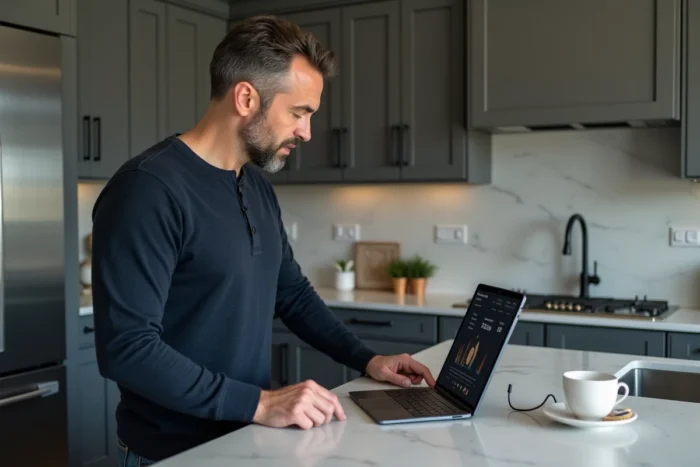
CES 2026 showcased systems where artificial intelligence no longer just responds to voice commands. According to iTPro.fr, next-generation home assistants proactively manage the home: energy-saving recommendations, peak consumption management, automated scenarios based on habits.
Difference Between Classic Automation and Proactive AI
A classic routine (turning off the lights at 11 PM) executes a fixed order. An AI-driven system analyzes your habits over several weeks, then adjusts heating or ventilation before you ask. Consumption adapts to the real rhythm of the household, not to a static schedule.
This approach, however, requires sharing more behavioral data with the system. The combination of GDPR and AI Act, some provisions of which come into effect in August 2026 according to Ayinedjimi Consultants, regulates the collection and processing of this data by manufacturers.
- Proactive systems must inform the user of the type of data collected and its purpose
- The user retains the right to disable machine learning without losing basic functions
- Energy consumption data remains under the control of the household, not the cloud provider, in compliant implementations
The connected daily life in 2026 is structured around three verifiable axes: Matter for interoperability, the Cyber Resilience Act for security, and embedded AI for energy optimization. The objects that check these three boxes are the ones that will remain connected in two years, not those that will end up at the back of the drawer.