
Car insurance premiums are increasing by about 6% on average in 2025. In this context, looking for the cheapest car insurance is no longer about finding an absolute bottom rate, but about identifying the insurers that best contain this price inflation. Here, we analyze the pricing mechanisms that explain the actual price differences between policies and insurers.
Deductibles and compensation limits: the variables that skew any price comparison
A contract advertised at a low price with a high deductible will cost more in the event of a claim than a slightly more expensive contract with a lower deductible. This is the point that most public rankings overlook.
The glass breakage deductible, for example, varies from one to three times depending on the insurer. For a windshield replacement, a deductible difference of 50 to 150 euros radically changes the actual cost of the contract for a driver who frequently drives on highways or in rural areas.
We recommend systematically relating the amount of the annual premium to the deductible level per coverage. A very low-priced third-party quote may hide a collision damage deductible greater than the residual value of the insured vehicle, which means paying for an unusable coverage. Consulting a comparison of the cheapest car insurance allows you to confront these parameters line by line rather than relying solely on the amount of the premium.
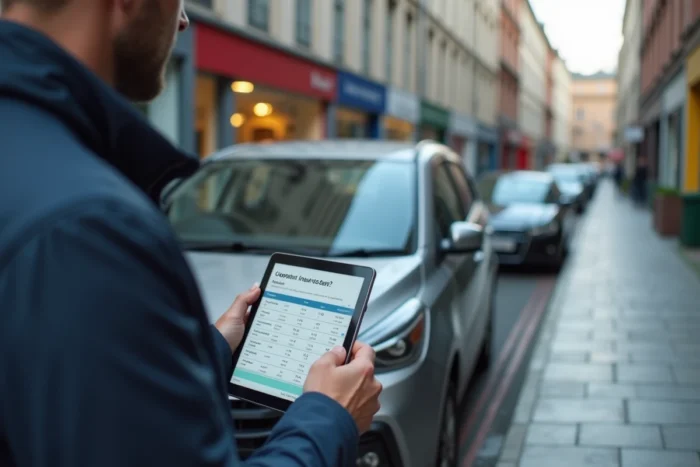
Third-party, extended third-party or comprehensive insurance: threshold switches by vehicle age
A vehicle over seven years old rarely justifies comprehensive coverage. The logic is arithmetic: when the market value of the vehicle falls below a certain threshold, the potential compensations in comprehensive coverage no longer offset the additional premium cost.
The extended third-party (or third-party plus) represents the most relevant compromise for recent used cars. This formula adds targeted guarantees (theft, fire, glass breakage, natural disasters) to the legal base of civil liability without the cost of comprehensive accident coverage.
Criteria for choosing between policies
- Argus value of the vehicle related to the annual comprehensive premium: if the premium exceeds 10% of the vehicle’s value, comprehensive coverage loses its financial interest
- Daily or occasional use: a secondary vehicle parked in a garage can suffice with extended third-party coverage with theft-fire guarantee
- Personal claims history: a favorable no-claims bonus reduces the comprehensive premium and can make this policy competitive, even on an older vehicle
Direct Assurance, Eurofil, and L’Olivier Assurance are among the insurers that maintain competitive rates across all three policy levels. On comparison sites like LeLynx, AcommeAssure, and Lovys, they regularly rank at the top for standard third-party profiles.
Driver profile and geographical area: why two identical quotes give different prices
The price of car insurance depends as much on the driver as on the vehicle. The parking location weighs as much as the no-claims bonus coefficient in calculating the premium. The same driver profile will pay significantly more in a dense urban area than in a rural area, with the same vehicle and policy.
Insurers segment their pricing grids by postal code, based on local claims frequency. Parking in a closed garage rather than on the public road can significantly lower the premium, a lever rarely exploited by policyholders.
Young driver: a structural but negotiable surcharge
The young driver surcharge remains one of the heaviest costs. It decreases gradually over three years without a responsible claim. A few levers can help reduce it from the outset:
- Validated accompanied driving: the initial surcharge is halved compared to a standard license
- Choosing a vehicle with low fiscal power, which mechanically lowers the calculation base
- Declaring as a secondary driver on a parent’s contract before taking out their own contract, to build up a no-claims bonus
Accompanied driving remains the most effective lever to reduce the young driver surcharge.

Rates 2025: what the average increase of 5 to 6% changes for choosing an insurer
The increase in premiums in 2025 is not uniform. Some insurers absorb part of the inflation on claims to maintain their market share, while others fully pass on the rising compensation costs.
The cheapest insurance in 2025 is the one that best limits the increase compared to the market average, not necessarily the one that shows the lowest rate in absolute terms. An insurer that increases by 2% when the market rises by 6% offers a real gain in purchasing power greater than a historically cheap competitor that applies the full increase.
We observe that online insurers (Direct Assurance, L’Olivier, Eurofil) retain a structural advantage due to lower distribution costs. This savings on management fees translates into premiums lower by several dozen euros per year for equivalent profiles.
Negotiate at the right time
The annual renewal of the contract remains the most effective negotiation window. Since the Hamon law, cancellation is possible at any time after the first year. Leveraging competition each year through multiple quotes remains the most reliable method to contain the cost of car insurance, more so than loyalty to a single insurer.
Comparing quotes must be based on an identical scope: same deductible level, same limits, same optional guarantees. Without this rigor, the displayed rate says nothing about the actual cost of coverage.