
An extra in catering refers to an employee hired under a fixed-term contract for a specific, time-limited mission. This type of contract meets a precise need: replacing an absent employee, a rush during an exceptional service, or a catering event. Finding extra staff quickly requires understanding the legal framework of the system even before posting an ad.
60-day threshold per quarter: the trap that turns an extra into a permanent employee
The HCR collective agreement sets a limit that is rarely anticipated by managers. An extra employed beyond 60 days in a calendar quarter can request the reclassification of their contracts into permanent employment. This rule applies per employee and per establishment.
In practice, a restaurateur who uses the same server three evenings a week for three months exceeds this limit without realizing it. Tracking cannot rely on memory: a precise count of shifts per person must be maintained, updated after each mission.
Not all matching platforms manage this tracking. Some display a profile’s availability without checking how many days that profile has already worked for the same employer. To map available offers and compare profiles, tools like the Personnel Extra website help identify candidates that match your search criteria.
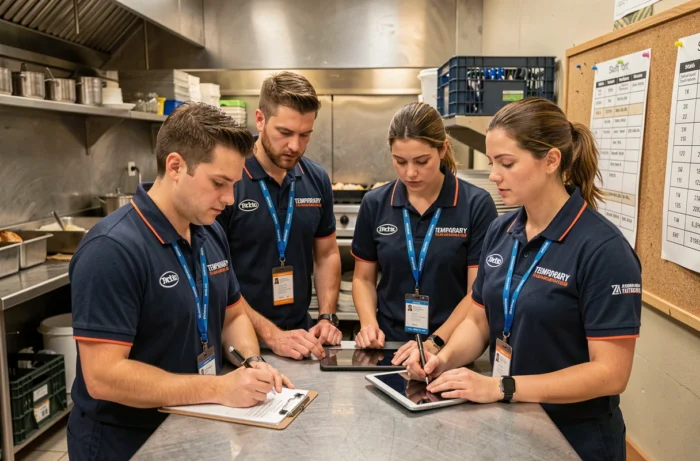
Extra contract and DPAE: administrative obligations for each shift
Each mission of an extra requires a separate contract. No framework contract covering multiple interventions, no simple amendment: a written contract per shift, signed before starting work.
The Prior Declaration of Employment (DPAE) must be submitted to URSSAF before the employee starts working. An oversight, even if unintentional, exposes the employer to penalties for concealed work. The unique document for assessing professional risks must also be accessible to the employee upon arrival.
This complete administrative traceability may seem burdensome for a temporary reinforcement of a few hours. In practice, it protects both parties. A properly declared extra benefits from social coverage, and the establishment avoids the risk of reassessment.
What the extra contract must mention
- The exact date and hours of the mission, with the reason for the request (replacement, temporary increase, event)
- The gross hourly wage, which cannot be lower than the conventional minimum for the position held
- The employee’s qualification and the exact nature of the tasks assigned during the shift
Building a pool of reactivatable extra staff
Posting an urgent ad on Friday for a service on Saturday rarely works. Reactivity relies on a pool built in advance, not on a last-minute search.
An effective pool groups profiles that have already been identified, contacted, and evaluated. After each mission, noting punctuality, technical mastery, and the employee’s adaptability allows for quick sorting of profiles during the next need.
Feeding the pool without waiting for urgency
Off-peak periods are the right time to recruit. In low season, more candidates are available and less sought after. Organizing a quick interview or a situational assessment of a few hours allows for skills verification before an urgent need arises.
Local hospitality schools are an underutilized source. Students nearing graduation seek temporary missions to complete their experience. A direct partnership with a school provides access to trained profiles even before they appear on platforms.

Recruiting extras: selection criteria beyond the CV
In catering, technical skill alone does not guarantee good integration during a service. An extra joins a team they do not know, in a place they are discovering, with service codes that vary from one establishment to another.
Three criteria allow for quick filtering of relevant candidates:
- Operational autonomy: the employee must be able to perform their role with minimal briefing, without requiring a permanent staff member to supervise them continuously
- Regularity of past missions: an extra who has worked regularly in comparable establishments (type of cuisine, volume of covers) adapts faster than a versatile profile without specialization
- Actual availability, verified and not declarative: confirming presence the day before the mission reduces last-minute drop-out rates
The main risk is not lacking candidates, but recruiting an unsuitable profile for the position. An experienced kitchen assistant in a collective setting does not necessarily master plating in a fine dining restaurant. Specifying the level of expectation in the offer avoids misunderstandings on the day of service.
Legal limits of fixed-term contracts for strengthening a team
The use of an extra is still governed by Article L1242-1 of the Labor Code. The fixed-term contract can only cover a genuinely temporary need. An establishment that employs extras year-round to compensate for structural understaffing exposes itself to judicial reclassification into permanent employment.
The distinction is simple on paper, but more blurred in practice. A restaurant that calls on three extras every weekend for several months no longer meets a temporary need. The judge looks at the recurrence of use, not the contract title.
Before multiplying shifts, the question to address is the sizing of the permanent team. If the need for reinforcement arises every week at the same times, a part-time contract or a permanent contract with flexible hours often costs less than the repeated administrative management of successive extra contracts.
Extra staff remains a lever of flexibility as long as legal thresholds are respected and it is not used as a permanent substitute for traditional recruitment. A well-maintained pool, compliant contracts, and rigorous tracking of days worked by each employee form the foundation of reliable management.