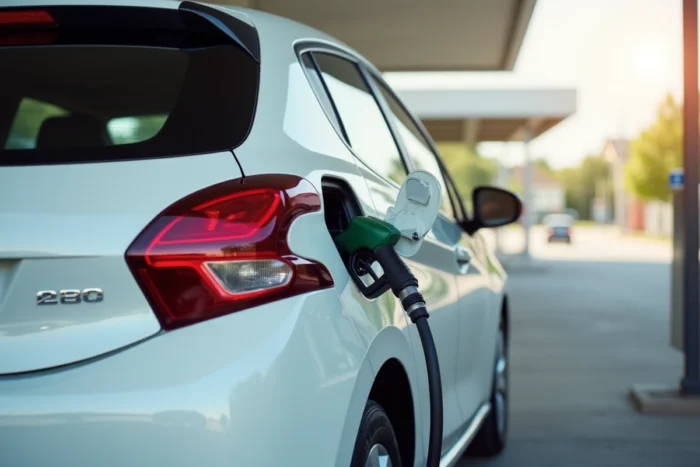
The BlueHDi 100 of the Peugeot 208 II remains an economical and enduring engine, but its relevance is now measured less at the pump than against traffic restrictions. Before choosing between petrol or diesel for the 208, it’s useful to ask a rarely addressed question: will the vehicle still be able to circulate where you need it in three or four years?
Used Diesel 208 and ZFE: Compatibility Takes Precedence Over Consumption
A BlueHDi 100 shows a real consumption significantly lower than that of a PureTech on the highway. This is indisputable. The problem is that the advantage per liter no longer compensates for regulatory constraints for the majority of buyer profiles.
Low emission zones now cover the main urban areas in France. A Crit’Air 2 diesel, even a recent one, risks being banned in certain metropolitan areas in the medium term. For a buyer living or working on the outskirts of Lyon, Marseille, Paris, or Strasbourg, this restriction weighs more heavily than a few centiliters saved per hundred kilometers.
The used car market already reflects this shift. Diesel 208s lose resale value faster than their petrol equivalents, precisely because the scope of use is shrinking. To better choose between petrol or diesel for the 208, you must first check if your circulation area will still be accessible to a Crit’Air 2 in the coming years.
Outside of the case of high-mileage rural or suburban drivers outside ZFE, diesel is no longer a default choice.
Reliability of the PureTech 208: The Engine Generation Changes Everything
Summarizing the petrol/diesel question to consumption ignores the real cost factor on a used 208: the reliability of the PureTech engine depends on the year of production.
The older versions, particularly the PureTech 82 produced before the correction phase, require increased vigilance regarding maintenance history. A preventive replacement of the timing belt on these engines represents a significant budget item.
What to Check Before Buying a Used PureTech
- The exact year and model of the engine: the corrections made by Stellantis on the timing relate to more recent productions, not the first batches
- The complete maintenance log with the oil change intervals respected, as abnormal oil consumption is the first warning sign
- The presence or absence of a timing belt replacement, especially on the early series PureTech 82 and 110
- The actual mileage relative to the age of the vehicle: a low-mileage but old PureTech may hide a dormant timing issue
Recent PureTechs and the 48V micro-hybrid versions are presented as technical responses to these early defects. A well-maintained post-correction PureTech is a reliable engine, but the amalgamation between generations remains the primary source of unpleasant surprises at purchase.
Manual or Automatic EAT8: A Choice That Affects Enjoyment and Budget
On the 208 II, the eight-speed automatic EAT8 is offered on the PureTech 130 and the BlueHDi 100. This is not just a comfort feature: the type of transmission significantly alters real consumption and the behavior of the three-cylinder engine.
The PureTech 100 with a six-speed manual gearbox offers the best compromise for mixed city-highway use. The manual gearbox remains lighter, less expensive to maintain, and does not suffer from any notable reliability issues on this model. The EAT8 is mainly justified on the PureTech 130, where the additional power better utilizes the eight gears on the highway.
On the BlueHDi 100 diesel, the EAT8 functions correctly but increases the purchase and maintenance costs. For regular highway use, it provides real comfort. For everything else, the manual is sufficient.
208 Petrol, Diesel, or Electric: Which Engine Based on Your Actual Use
The electric e-208 does not fall under the same calculation as thermal engines, but it enters the comparison for a simple reason: unrestricted access to ZFE and the absence of penalties. For an urban driver who never leaves the metropolitan area, the electric option eliminates the regulatory question.
For others, the reading grid remains technical:
- Predominantly urban use with some suburban trips: PureTech 100 manual, the best cost/reliability versatility ratio
- High-mileage rural or highway drivers regularly exceeding long trips outside ZFE: BlueHDi 100, still economical and enduring in this terrain
- Exclusively metropolitan use with charging at home or work: e-208, which eliminates Crit’Air and fuel constraints
- Need for power on the highway with driving comfort: PureTech 130 EAT8, provided you accept the additional cost at purchase
The choice of engine on the Peugeot 208 is no longer just about comparing liters per hundred kilometers. Regulatory compatibility and the exact generation of the engine weigh as much as consumption in the total cost of ownership. A well-targeted diesel remains defensible, a recent PureTech remains reliable, but neither is suitable for all profiles. Asking about usage before fuel type is the only way to avoid a poor decision.