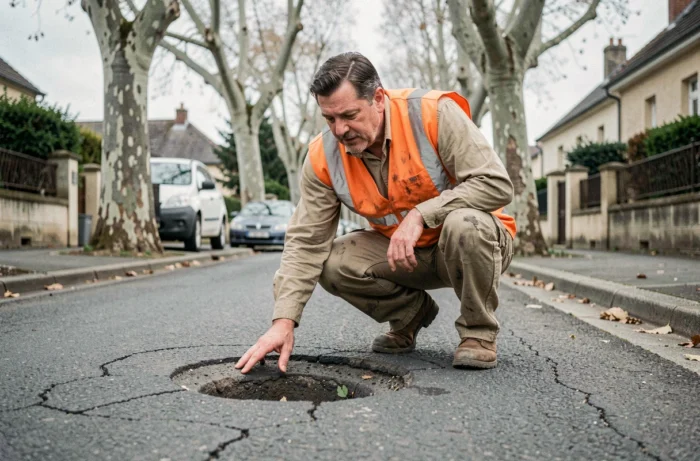
Municipalities and inter-municipalities manage 65.5% of the French road network, which amounts to 717,000 km of roads and 120,000 bridges, without dedicated tax revenue. This asset represents an annual expense of 7.1 billion euros for municipalities with more than 3,500 inhabitants, according to the DGCL. How can we compare management approaches to identify those that truly reduce costs and preserve the state of the network?
Preventive or curative road maintenance: real cost gap
Cerema summarizes the logic in one formula: 1 euro invested today to adapt the road avoids 5 to 6 euros tomorrow. This data changes the interpretation of road budgets.
| Strategy | Intervention Timing | Relative Cost | Effect on Lifespan |
|---|---|---|---|
| Preventive maintenance (surface treatment, light reprofiling) | At the first signs of aging | Base (1x) | Extends the lifecycle by several years |
| Localized repair (patching, filling) | Isolated visible damage | Moderate (2-3x) | Stops the spread without restoring the structure |
| Heavy reconstruction (excavation, foundation repair) | Structurally degraded roadway | High (5-6x) | Renovates, but requires a multi-year budget |
The difference does not lie in the quality of materials. It lies in the timing of the decision. A municipality that schedules a surface treatment on a road still in decent condition spends a fraction of what a complete reconstruction will cost five or ten years later, when the cracks have reached the foundation layer.
The resources dedicated to the maintenance of municipal roads on Déco en Vogue detail this logic of prioritization applied to the budgets of small and medium-sized municipalities.
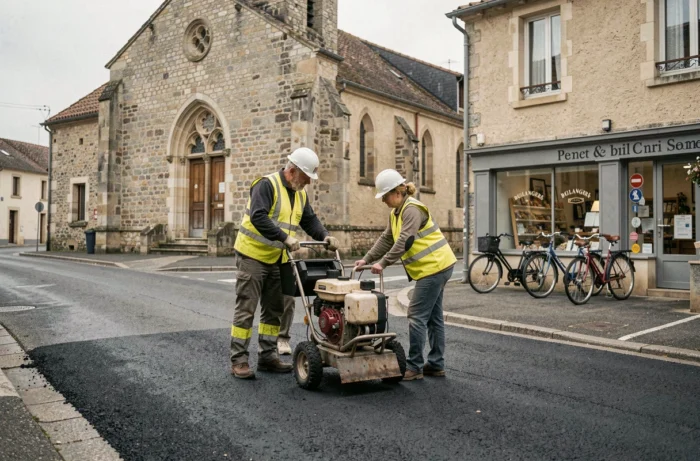
Inventory of the road heritage: the basis for reliable management
Scheduling work without knowing the precise condition of each road is akin to making decisions blindly. Cerema emphasizes the use of measurable heritage indicators to classify roads by level of degradation and priority of intervention.
An operational inventory relies on several components:
- The geometry of each road (width, cross-section, type of surface), which determines the technical choice of intervention.
- The surface condition assessed through visual inspection or monitoring tools (cracking, rutting, crazing), translated into a score or condition index.
- The traffic level and the function of the road within the municipal network (local access, transit, fire access), to prioritize roads according to their criticality.
Without this initial snapshot, decisions are made under political pressure or in reaction to complaints from residents. The direct consequence: the noisiest roads capture the budget, not the most structurally degraded ones.
Multi-year programming versus ad-hoc management
Once the inventory is completed, multi-year programming allows for smoothing investments over three to five years. The logic is that of the lifecycle: each road is positioned on a degradation curve, and the intervention is planned before the tipping point towards heavy reconstruction.
In contrast, purely reactive management concentrates spending on emergencies. Maintenance delays accumulate and accelerate the overall degradation of the asset, which industry professionals refer to as grey debt.
Legal responsibility and coordination among road managers
The boundary of responsibility between the municipality, department, and state remains a sensitive issue, particularly in urban areas. For national and departmental roads crossing a municipality, the maintenance of the roadway falls under the managing owner (state or department).
The mayor retains traffic control and safety of passage. This distribution requires fine operational coordination among managers, far beyond what general guides suggest.
Three situations regularly generate friction:
- A pothole on a departmental road in the town center: the department must intervene, but the mayor receives complaints and bears the responsibility of signaling the danger.
- Network works (water, sanitation, fiber) that degrade a municipal road: the restoration is the responsibility of the contractor, but the municipality must verify the quality of the repair.
- Adaptation to climate change (submersion, shrink-swell of clays) that weakens roads whose initial design did not account for these constraints.

Digital tools for managing the municipal road network
Recent business solutions rely on the inventory, geometry, usage, and condition of the roadway to automatically generate maintenance objects and plan intervention schedules. This approach, developed nationally by the TRA tool from ASTRA for national roads, is gradually being adapted to municipal networks.
The main contribution of these tools lies in their ability to cross-reference the measured condition of a road with its traffic level and intervention cost. The manager obtains an objective ranking of priorities, documented and defensible in case of disputes.
Field data thus becomes the foundation for decision-making. A municipality that digitizes its road heritage can justify its budgetary choices before the municipal council with factual elements, not just the visual impression of an elected official or an agent.
Limits to anticipate
Digitizing the network has an entry cost: field survey, initial data entry, training of agents. For rural municipalities with limited technical staff, support from departmental technical agencies remains crucial to initiate the process without overburdening the teams.
The French municipal road network, estimated as a whole to have considerable heritage value, deteriorates when decisions are made without data. Transitioning from an emergency repair logic to a programming based on the actual condition of the roads remains the main lever to control road spending in the long term.