
A rental real estate project should not be judged solely on its displayed gross yield. We regularly observe investors attracted by an appealing nominal rate who overlook the regulatory trajectory of the building, the actual structure of expenses, or the property’s future liquidity. Selecting a profitable and sustainable real estate project requires cross-referencing financial, technical, and environmental criteria from the analysis phase, not after signing.
Building lifecycle and total operating cost
The rental profitability calculated on the purchase price and monthly rent reflects only a fraction of the actual performance. The total cost encompasses the entire lifecycle, from the quality of construction materials to predictable maintenance expenses over fifteen or twenty years.
A building delivered with equipment that meets the latest thermal requirements (RE2020 for new buildings in France) mechanically generates lower operating costs. We recommend systematically requesting the projected energy balance and estimated maintenance costs before any commitment.
A common mistake is to compare two projects based solely on their price per square meter. A less expensive property that is energy-intensive or built with short-lived materials will eventually absorb the price difference in renovation work and rental vacancy due to obsolescence. To learn more about H Immobilier, their selection methodology illustrates this approach through total cost rather than nominal yield.
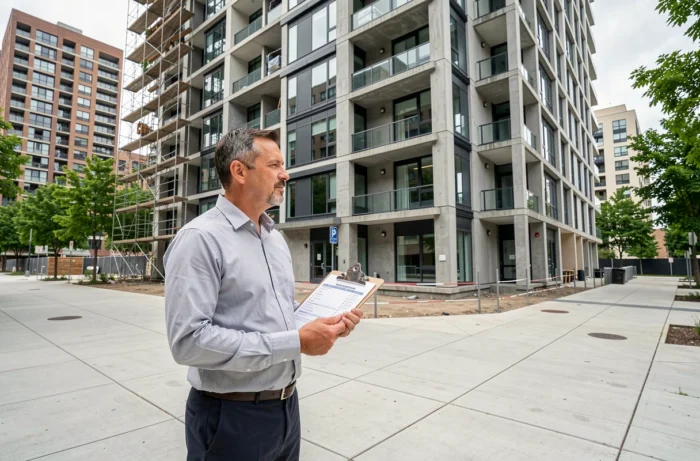
ESG grid applied to real estate project selection
ESG criteria (Environmental, Social, Governance) are no longer just marketing. They now structure the analysis of real estate assets along three concrete axes that directly influence the property’s value and its ability to generate stable rental income.
Environmental footprint of the building
A DPE rated F or G progressively excludes the property from the rental market. The French regulatory timeline already prohibits the rental of thermal sieves rated G, and restrictions will extend to the following classes in the coming years. Incorporating this trajectory into the investment calculation radically alters the projected net profitability.
We analyze energy performance not as a comfort label, but as an indicator of asset risk. A project that complies with future regulatory thresholds upon delivery preserves its resale value and rental capacity without additional work.
Quality of living and governance
The social aspect covers the quality of common areas, accessibility, sound insulation, and brightness. These elements determine the occupancy rate and tenant retention, two variables often underestimated in yield projections.
Governance concerns the transparency of the developer or manager: delivery history, management of reserves, post-delivery follow-up. A developer who is opaque about their timelines and guarantees increases the operational risk of the project, even if the financial fundamentals seem solid.
Net rental yield: the items that the gross calculation ignores
Gross profitability (annual rent divided by purchase price) serves as a quick sorting indicator. It is never sufficient to qualify a project. Net profitability incorporates the following items, often minimized in commercial simulations:
- Non-recoverable co-ownership charges, property tax, non-occupying owner insurance, and rental management fees (count between one and two months of annual rent depending on the manager)
- Provision for rental vacancy: even in tight markets, a tenant turnover rate generates periods without income that must be budgeted
- Routine maintenance and progressive compliance work, particularly on heating systems and insulation
- Actual taxation after applying the chosen regime (micro-property, real, LMNP), which can turn an apparently profitable project into a neutral or even deficit operation
Net profitability after tax is the only reliable indicator for comparing two projects against each other. We regularly observe discrepancies of two to three points between the announced gross yield and the actual net yield once all items are integrated.

Local rental market: demand indicators and property liquidity
The analysis of the rental market is not limited to the average rent price in a city. Three operational indicators allow us to qualify the strength of demand.
The ratio between available supply and active demand on listing portals provides a snapshot of the likely re-rental timeframe. A market where listings remain online for several weeks indicates an excess of supply that will weigh on negotiable rent.
The diversity of potential tenant profiles (students, young professionals, families, seniors) reduces the risk of dependence on a single segment. A two-room property close to a university hub and a tertiary employment area attracts multiple targets, stabilizing the occupancy rate.
The liquidity of the property upon resale remains a frequent blind spot. A project located in a dynamic city but in a neighborhood saturated with identical new programs will see its potential appreciation compressed by competition. Checking the volume of delivered or ongoing programs in the immediate area avoids unpleasant surprises over a ten-year horizon.
Regulatory trajectory and future value of the real estate project
The French regulatory framework regarding energy performance evolves in stages. Each stage alters the boundary between a rentable property and one prohibited from rental, which directly impacts resale price and income-generating capacity.
A project selected today must anticipate requirements in five and ten years. This means prioritizing performance levels above the current minimum regulatory standards. The initial additional cost is generally offset by the absence of subsequent corrective work and by a slightly higher rent justified by reduced charges for the tenant.
Projects that incorporate bio-sourced materials or reversible energy systems (heat pumps, self-consumption solar panels) from the design stage gain resilience against future standards. This is not a comfort argument; it is a long-term asset risk management criterion.
Ultimately, the analysis of a profitable and sustainable rental investment relies on a trade-off between immediate yield and structural robustness. A project that ticks the boxes for gross yield but ignores the lifecycle, the ESG grid, and the regulatory trajectory exposes the investor to a silent erosion of their actual net profitability.