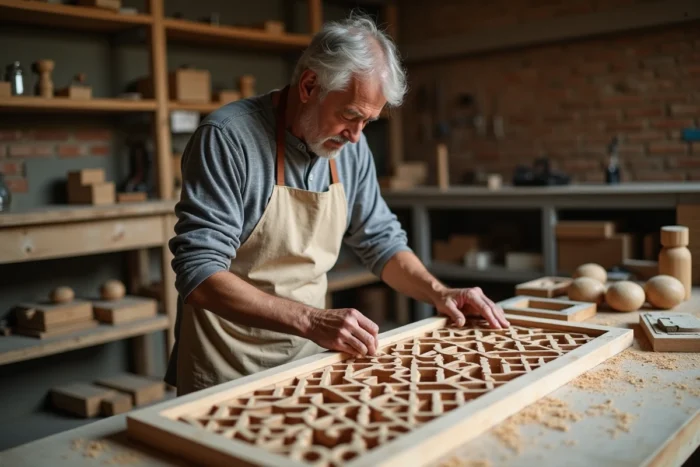
When you want to partition a room without closing it off, the wooden moucharabieh raises an immediate question: what level of complexity can you manage yourself, and when should you go through a cutting workshop? The answer depends on the chosen pattern and the available tools. Here are the technical points that make the difference between a successful panel and a disappointing assembly.
Vector file and digital cutting: the true starting point of a moucharabieh
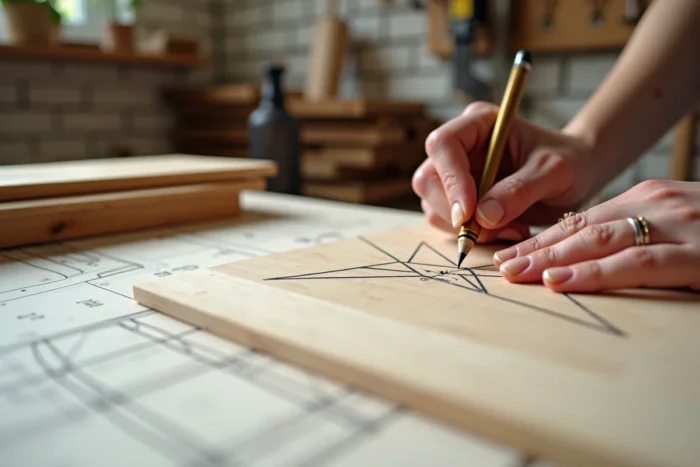
We rarely start with wood. We start with a drawing. Digital cutting workshops (CNC or laser) today offer co-design services where you begin with a vector file in DXF or SVG format. The pattern is adapted to the thickness of the panel, the type of wood, and the desired mechanical strength.
This step radically changes the manufacturing process compared to traditional manual turning. With a well-calibrated file, the cutting precision no longer depends on the skill level of the DIYer but on the machine. You send the file, retrieve the pieces, and assemble.
Before drawing anything, you need to test the pattern at full scale. Several wood carving guides emphasize this point: printing the pattern at a 1:1 scale on paper allows you to check the strength of the bridges (the solid parts between the openings). A bridge that is too thin may break during assembly or after a few months. On softwood, the bridges should remain wider than on hardwood.
For those who want to make a wooden moucharabieh without going through co-design, prefabricated panels in MDF or multilayer wood with patterns already laser-cut offer a quick alternative. They come in standard sizes suitable for doors, cabinets, and partitions.
Choosing the wood species for a durable moucharabieh
The choice of wood species affects both aesthetics and longevity. Indoors, MDF is often used for its cost and surface uniformity, but the result remains flat. Solid wood provides a visual depth that MDF cannot replicate.
Hardwood or softwood: what CNC cutting requires
A hardwood (oak, beech) better withstands fine open patterns. The bridges can be reduced to a few millimeters without risk of breaking. However, CNC cutting on hardwood requires suitable bits and longer machine time, which increases manufacturing costs.
A softwood (pine, poplar) cuts quickly and is cheaper. Feedback varies on this point, but it is often observed that very open patterns lose sharpness on softwoods, with fibers tearing around the edges of the cuts. Careful sanding can mitigate some of the issue.
- Oak or beech: suitable for fine patterns, durable, oiled or waxed finish to maintain visible grain
- Quality MDF: smooth surface ideal for painting, economical, but sensitive to moisture in outdoor use
- Pine or poplar: good value for large panels with wide patterns, to be treated with a matte varnish to limit yellowing
- Multilayer wood (birch plywood): stable, does not warp, good compromise for partition walls
Assembly and fixing the moucharabieh panel in space
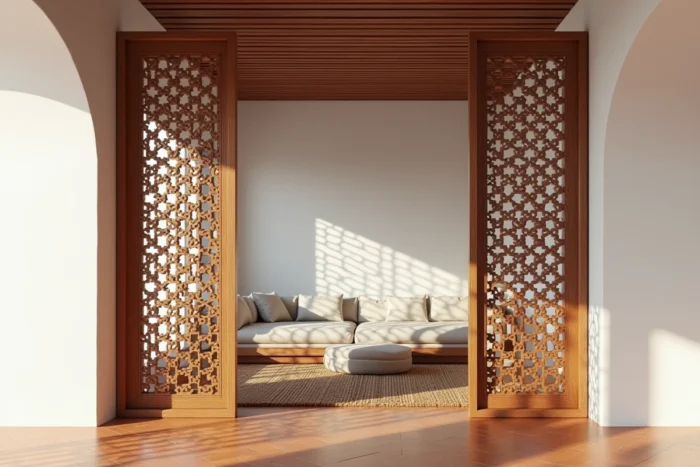
The panel is cut, sanded, and treated. The question of installation remains, which determines the final effect in the room. A moucharabieh can serve three distinct functions: space separation, wall covering, or a screen in front of a light source.
Separator screen between two rooms
A frame made of battens screwed to the floor and ceiling constitutes the simplest structure. The moucharabieh panel is fixed within this frame with screws hidden from the back or with fixing clips. The frame absorbs the irregularities of the floor and ceiling, which the panel alone cannot compensate for.
For renters or those who do not want to drill, a self-supporting frame weighted at the base works, provided that the panel does not exceed a certain height. Beyond that, stability becomes a real issue.
Decorative wall covering and light play
Fixed a few centimeters from the wall with spacers, the moucharabieh creates a play of cast shadows as soon as a light source is behind it. The gap between the panel and the wall determines the sharpness of the shadows: the larger the gap, the blurrier the outlines. A spacing of a few centimeters yields a sharp result with LED lighting positioned around the perimeter.
Finishing and treating the wooden moucharabieh
The finish protects the wood and influences the perception of the pattern. On a moucharabieh, the surfaces are narrow and there are many edges, which complicates the application of a thick product like a glossy varnish.
- Hard oil (linseed or tung): penetrates the wood without forming a film, ideal for maintaining a natural feel and highlighting the grain
- Matte spray paint: uniform coverage on open patterns, particularly suitable for MDF painted white or black for a graphic effect
- Stained glaze: a good compromise for protected outdoor use (covered terrace, pergola), to be renewed regularly
Applying the finish before final assembly avoids untreated areas in the corners of the pattern. Each panel is treated flat, allowed to dry, then assembled. This sequence simplifies the work and improves durability.
The wooden moucharabieh is not limited to an oriental pattern applied to a panel. It is a separating element, of light and ventilation, whose success depends on three concrete choices: the cutting file, the type of wood, and the method of fixing in space. The pattern comes afterward.