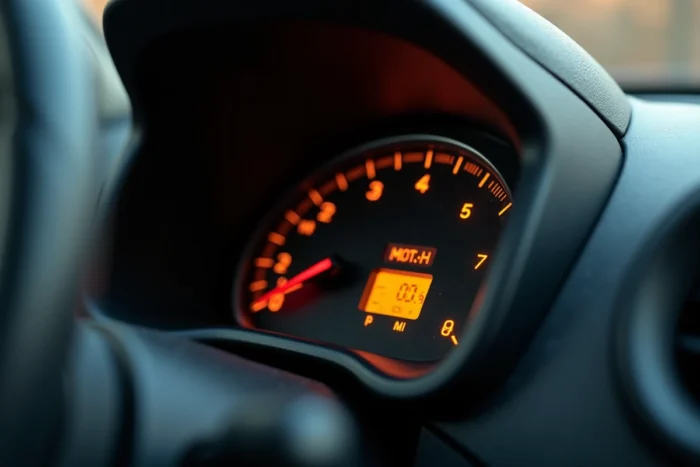
The Twingo 2 petrol has a fuel tank of about 40 liters according to Renault’s technical specifications, regardless of the engine type (1.2 60 hp, 1.2 75 hp, 1.2 TCe, or 1.6 RS). When the reserve light comes on the dashboard, how many kilometers are actually left before running out of fuel? The answer depends on the amount of fuel remaining at the time of the alert, as well as driving style and the type of journey.
Tank and reserve threshold: technical data for the Twingo 2
On Renault city cars of this generation, the reserve light activates when there are about 5 to 7 liters left in the tank. This range, confirmed by several technical sources dedicated to the Twingo, corresponds to the typical threshold for small French petrol cars.
With a mixed consumption of around 6 to 7 L/100 km for the 1.2 engines, the calculation gives a theoretical range in reserve between 70 and 115 km. The commonly accepted range for the Twingo 2 petrol is rather between 80 and 100 km of reserve range.
A detailed guide allows you to estimate how many kilometers are left in reserve on the Twingo 2 petrol depending on the exact engine type and driving conditions.
| Twingo 2 Engine | Tank | Estimated Reserve | Reserve Range (estimate) |
|---|---|---|---|
| 1.2 60 hp | ~40 L | 5 to 7 L | 80 to 100 km |
| 1.2 75 hp | ~40 L | 5 to 7 L | 80 to 100 km |
| 1.2 TCe 100 hp | ~40 L | 5 to 7 L | 70 to 95 km |
| 1.6 RS 133 hp | ~40 L | 5 to 7 L | 60 to 80 km |
The 1.6 RS consumes significantly more than the 1.2 engines, which reduces the distance that can be traveled with the same reserve volume. In contrast, the 1.2 60 hp, the most economical in the range, offers the best margin.
Consumption discrepancies: why the reserve distance varies so much
Displaying a range of 80 to 100 km is not enough. In practice, two identical Twingo 2 petrol drivers can observe a discrepancy of 30 to 40 km in reserve range. The parameters that widen this gap deserve to be detailed.
Speed and type of journey
The consumption of a Twingo 2 1.2 in the city can rise to 8 or 9 L/100 km depending on traffic. On the road at 90 km/h, it often drops below 6 L/100 km. Driving on a fast lane with the reserve significantly extends the distance that can be traveled compared to an urban journey with frequent stops.
Loading and vehicle condition
A loaded trunk, under-inflated tires, or a clogged air filter increase consumption by several tenths of a liter per 100 km. With a reserve volume limited to 5-7 liters, these tenths translate into a significant loss of distance.
- Under-inflated tires: rolling resistance increases, which puts more strain on the remaining fuel
- Air conditioning running: on a small 1.2 engine, the compressor load can add 0.5 to 1 L/100 km in the city
- Aggressive driving style: sudden accelerations and repeated braking consume more than smooth and anticipatory driving
All these cumulative factors can shift the reserve range from 100 km to less than 60 km, even on the most economical engine.
Driving on reserve in the Twingo 2 petrol: the real risks
Pushing the reserve to its limits exposes you to problems that go beyond simply running out of fuel on the side of the road.
The fuel pump suffers when the level is very low. Immersed in the tank, it uses the surrounding gasoline to cool itself. Regularly driving with the light on accelerates its wear and can lead to premature replacement, a repair whose cost represents several full tanks of fuel.
On injection engines, an almost empty tank also promotes the suction of residues and impurities accumulated at the bottom of the tank. These particles strain the fuel filter and can disrupt the injectors in the medium term.
- Premature wear of the fuel pump due to lack of cooling
- Suction of sedimented impurities at the bottom of the tank
- Accelerated clogging of the fuel filter and injectors
- Risk of stalling in an area without a gas station, with breakdown assistance required
Twingo 2 reserve light: reliability of the alert
The fuel level sensor (gauge) of the Twingo 2 is a mechanical float connected to a variable resistor. This simple and proven system has a limitation: the accuracy varies depending on the vehicle’s tilt and the wear of the sensor.
On an aging model, the float may get stuck or lose accuracy. The reserve light then comes on earlier or later than expected. Some Twingo 2 owners report on forums erratic triggering, with a light that comes on in a turn and then goes off on flat ground.
Relying solely on the light without considering the mileage since the last fill-up is therefore risky. A simple habit is to note the mileage at each fill-up and calculate the actual consumption over several cycles. This gives a much more reliable estimate than the light alone.
For the Twingo 2 petrol, keeping a safety threshold of 50 km after the light comes on allows for a comfortable margin, regardless of the type of journey or the condition of the sensor. Exceeding this threshold without refueling exposes you to an increasing risk of running out of fuel, especially in rural areas where gas stations can be several tens of kilometers apart.