
In home care structures, every minute counts. Between travel times, interventions with beneficiaries, and mandatory breaks, reconstructing the actual hours of an intervenor after the fact is a puzzle. Paper sheets pile up, data entry errors multiply, and billing gets delayed. It is precisely this administrative knot that the Philia ADMR platform targets by offering a time tracking solution adapted to the realities on the ground.
Remote management and field clocking: what changes concretely for the intervenor
Have you ever tried to note your hours in a notebook after a day of six interventions? The exercise is thankless. Forgetting is common, rounding becomes the norm, and the sector manager then spends hours verifying the consistency of the declarations.
With a remote management tool like Philia, the intervenor clocks in directly from the beneficiary’s home. The smartphone or device records the arrival and departure times in real-time, without complex manipulation. This automated clocking eliminates manual re-entry and ensures time tracking with Philia ADMR is reliable for each intervention carried out.
The travel time between two homes is also captured. This is a point often overlooked in generic scheduling solutions, which do not distinguish between travel and intervention. In the home care sector, this distinction affects remuneration and regulatory compliance.
National base rate and hour tracking: why precision becomes strategic
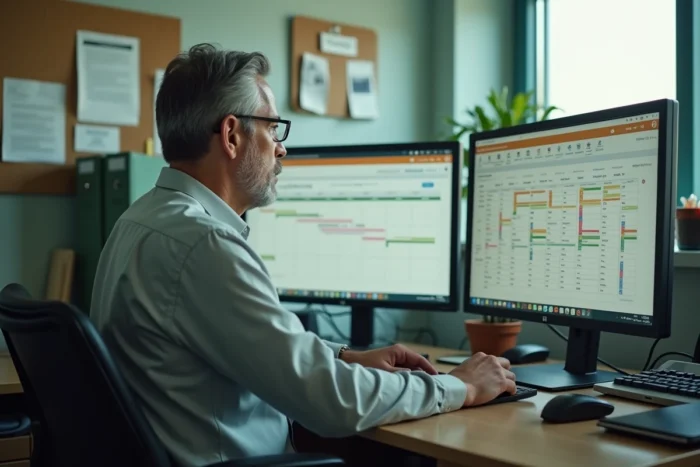
The regulatory context pushes ADMR associations to strengthen their tracking tools. The CNSA confirmed in 2025 the increase of the national base rate for home care to 24.58 euros per hour for APA and PCH. This rate applies to hours actually worked and justified.
In other words, every untracked or poorly documented hour can lead to a gap between the service provided and the funding received. For a federation managing hundreds of intervenors, the financial stakes are direct.
Philia allows each clocking to be linked to a beneficiary, a type of service, and a specific time slot. The service manager has a real-time dashboard, without waiting until the end of the week to consolidate the data. Billing relies on verified hours, not on estimates.
The trap of unreported additional hours
In many structures, intervenors extend an intervention by a few minutes to finish a task. These overruns, repeated over a month, represent a significant volume of hours. Without a reliable clocking tool, they go unnoticed: neither paid nor billed.
Remote management makes these overruns visible. The planned schedule is automatically compared to the actual schedule, allowing for adjustments in intervention durations or signaling an unbalanced workload.
Adoption on the ground: the role of the user committee
A digital tool is only as good as its actual adoption. Feedback from the sector shows that a user committee involving the intervenors significantly improves deployment. This is an angle that competing pages overlook, even though it conditions the project’s success.
Specifically, this committee brings together home care aides, sector managers, and digital referents. It raises issues (too small screens, too long clocking sequences, lack of network coverage for some beneficiaries) and proposes adjustments.
- Regular field feedback allows for bugs to be corrected before they discourage teams, rather than after a massive deployment.
- Initial training becomes more relevant when it is based on real use cases reported by the intervenors themselves.
- The sense of involvement reduces resistance to change, which is common in a sector where digital is not always seen as an ally.
Without this feedback loop, even the best platform ends up underutilized.
Scheduling and right to respite: managing the complexity of caregiver leave
The home care sector faces increasing complexity in absences. The right to respite, caregiver leave, and other fractional arrangements multiply the special cases in scheduling management.
Philia integrates these parameters into the construction of the intervenor’s schedule. When an employee takes fractional leave, the schedule readjusts and interventions are redistributed to available colleagues. The beneficiary does not experience a service interruption, and the sector manager does not need to manually recompose each time slot.
Continuity of service and caregiver workload
Recent data shows an intensification of the caregiver workload for family caregivers and an increased organizational fragility of home services. A reliable time tracking tool secures continuity: if an intervenor is absent, the system quickly identifies who can replace them, in which time slot, and with what travel time.
This is not just administrative comfort. It is a condition for maintaining the quality of service for individuals who are often dependent.
Philia ADMR versus generic scheduling tools
Planning software like Evolia or MyPYLI HR offers robust features for tracking timesheets. Their limitation, in the ADMR context, lies in their design: they are intended for teams working at a fixed site, not for itinerant intervenors visiting multiple homes per day.
Philia stands out on three specific points:
- The tracking of travel times between two interventions, natively integrated into the clocking.
- The linking of each hour to an identified beneficiary, with the type of service (APA, PCH, comfort service).
- Compatibility with the pricing rules of the medico-social sector, not just with general labor law.
A generic tool can manage shifts. It cannot distinguish between an hour of APA support and an hour of cleaning billed at a different rate. This granularity is what makes Philia relevant for ADMR associations.
Time tracking in home care is not just a matter of productivity. It is an issue of compliance, fair remuneration, and continuity for beneficiaries. Structures that invest in a tool suited to their field constraints, rather than in a generic software, gain reliability on each of these three fronts.