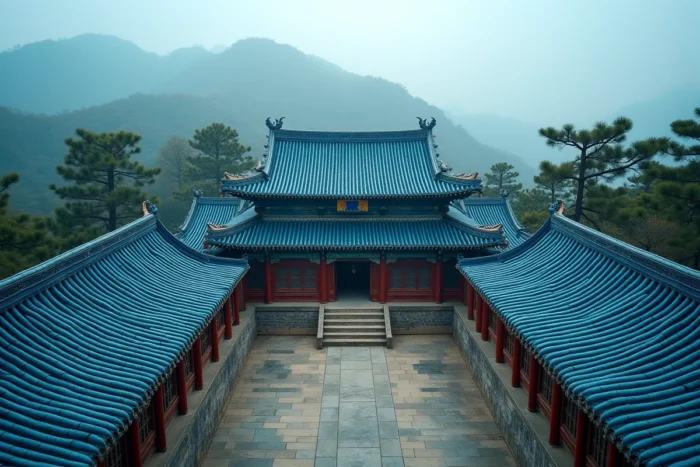
The blue roofs observed on Chinese temples and historical buildings are not merely a decorative choice. They are part of an architectural code system where each tile color indicated a rank, a function, a connection to the cosmos. In this system, blue holds a special place: that of the sky.
Glaze and firing: what gives Chinese tiles their blue shine
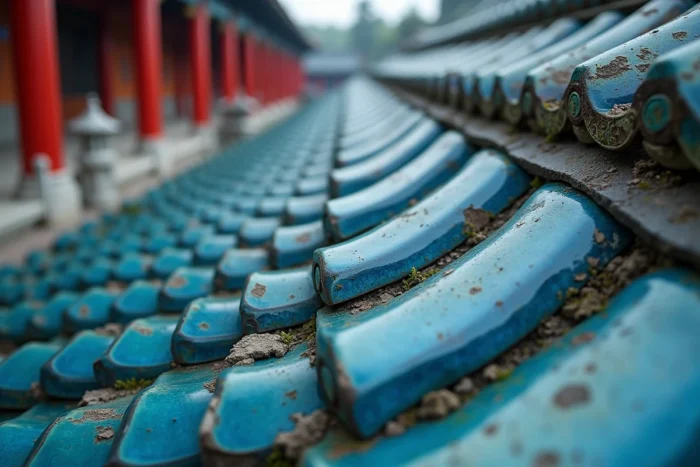
The shiny, almost lacquered appearance of blue roofs in China comes from an ancient manufacturing process. A glaze, a mixture of minerals and metal oxides, is applied to clay tiles before high-temperature firing. This step transforms the tile’s surface into a vitrified layer, waterproof and weather-resistant.
The blue obtained depends on the exact composition of the glaze and the firing conditions. Artisans adjusted these parameters to produce shades ranging from deep blue to blue-green. The vitrified glaze protects the tile as much as it colors it, which explains why roofs that are centuries old still retain their hue.
This know-how, which also traveled along trade routes to Central Asia and the Mediterranean (related techniques can be found in Iznik ceramics in Turkey), remains a reference for understanding about blue roofs in China and what distinguishes them from the glazed roofs of other architectural traditions.
Chinese cosmology and the color of the sky: why blue on temples
In traditional Chinese cosmology, blue directly represents the sky. This association is not metaphorical: it stems from a system of correspondences between the five elements (metal, wood, water, fire, earth), cardinal directions, and colors. Blue (and green, often grouped under the same term in classical Chinese) corresponds to the east, wood, and spring.
The Temple of Heaven in Beijing illustrates this logic in the most direct way. Its triple roof of blue glazed tiles is not an ornament: it materializes the belief that the sky is round and the earth is square. The emperor, “Son of Heaven,” performed rituals there to ensure the proper functioning of the cosmos. The blue of the roof symbolically placed him under the celestial vault.
The cultural mediation devices offered to visitors of the Temple of Heaven emphasize this cosmological reading. The celestial symbolism of blue is not only inherited: it is constantly updated in the official discourse on Chinese heritage.
Color code of roofs in imperial China: hierarchy and restrictions
Reducing blue roofs to their spiritual dimension would be incomplete. The color of the tiles functioned as a marker of social and political rank in imperial China, with strict rules.
- Yellow tiles were reserved for imperial palaces, mausoleums, and the emperor’s gardens. Yellow represented the earth at the center of the universe and supreme power.
- Green tiles covered the residences of court officials and certain members of the nobility.
- Blue tiles were associated with religious buildings related to the worship of Heaven, such as the Temple of Heaven.
- Black tiles were found on structures intended for the public without noble titles, such as landscape pavilions.
This system was not indicative: it had the force of law. Using a tile color above one’s rank could constitute an offense. The color of the roof allowed the identification of a building’s function and the status of its occupants from a distance, even before entering.
The available data do not allow for precise dating of the emergence of each restriction, but the system was clearly codified during the Ming and Qing dynasties, the period when most of the grand imperial complexes we visit today were built or renovated.
Blue roofs in contemporary China: between heritage and urban transformation
Blue roofs did not disappear with the end of the empire. They can be found on Buddhist temples, restored heritage buildings, and, in a very different version, on modern rural and suburban constructions. The latter use blue corrugated sheets, an industrial material that has nothing to do with traditional glaze, but which extends, through color, a form of visual continuity.
The blue of industrial sheets and that of glazed tiles belong to two distinct logics. The cheap blue sheets seen on millions of buildings in East Asia are an economic choice. The blue glazed tiles placed on restored temples are a heritage choice, framed by conservation standards.
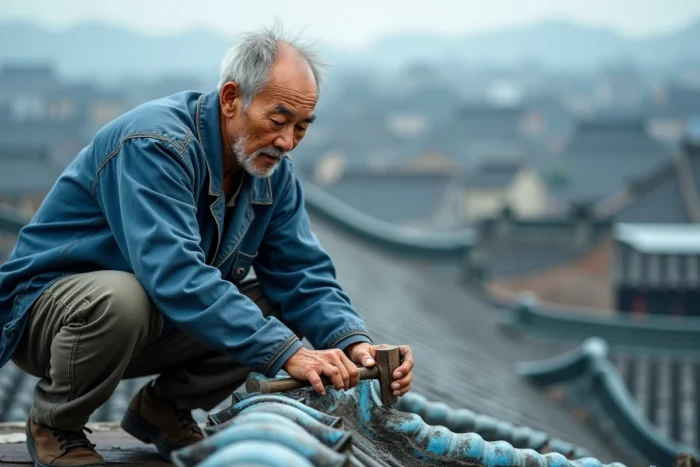
At the Temple of Heaven, for example, successive restorations have maintained traditional glazing techniques. The site, classified as a World Heritage site, receives special attention regarding the authenticity of materials. Recent tourist circuits explicitly present the triple blue roof as a symbol of the cosmology “round sky, square earth,” proof that the meaning of blue remains an active tool of cultural transmission.
Pagodas, Buddhist temples, and blue roofs: a nuanced connection
The association between pagodas and blue roofs deserves clarification. Chinese pagodas, structures linked to Buddhism, do not systematically feature blue roofs. The color of their roofs depends on the time of construction, the region, and the religious current concerned.
Chinese Buddhism has integrated elements of local cosmology, but its color codes do not exactly overlap with those of imperial Confucianism. Some Buddhist temples have green roofs, others gray roofs. Blue appears mainly when the temple has a connection to the worship of Heaven or when the restoration followed the conventions of the imperial period.
Field reports vary on this point: depending on the regions and local traditions, the color palette of religious buildings varies considerably. Generalizing blue to all of Chinese sacred architecture would be a simplification.
The blue roof in China remains an architectural object whose interpretation changes depending on whether it is viewed from the perspective of imperial history, cosmology, contemporary heritage, or urban landscape. Its persistence is less due to inertia than to the country’s ability to reactivate, generation after generation, the symbolic weight of a color on a roof.