
The sketchbook functions as a private laboratory, but it does not prepare for what admission juries actually expect. Between the free gesture with a pencil and the requirements of an illustration program, several intermediate skills remain invisible until they are identified. Here we detail the concrete steps, emphasizing what generalist paths overlook.
Visual culture and image reading: the criterion that sketchbooks do not address
Art preparatory schools and art schools increasingly emphasize the ability to analyze contemporary images rather than just mastering line work. Short formats, visual codes of social media, raw collages: knowing how to read and comment on an image is as important as knowing how to produce one.
A sketchbook filled with observational drawings proves discipline, not visual thinking. Juries want to see if the candidate can dissect a poster, explain why a framing works, and situate a reference within a graphic movement. This work of artistic culture cannot be improvised the day before an interview.
We recommend dedicating part of each drawing session to a decryption exercise: choose an image (advertisement, graphic novel cover, press photograph), partially redraw it, and then note in the margins what structures its composition. This back-and-forth between analysis and practice builds exactly the perspective that training programs seek. Those who wish to move from the sketchbook to illustration school benefit from structuring this approach from the very first months.
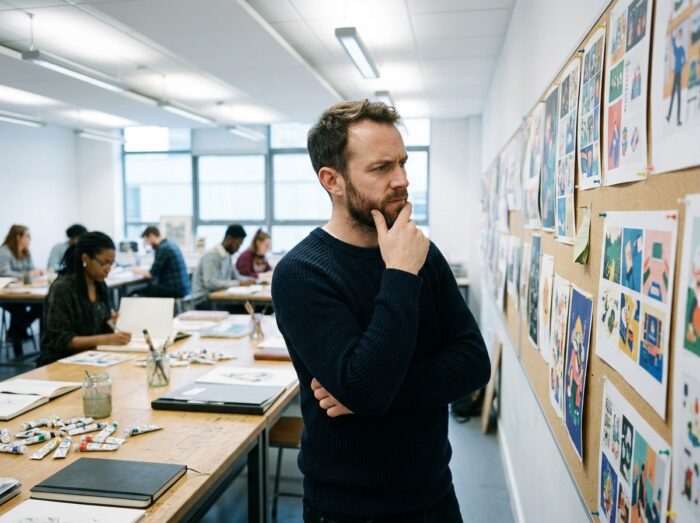
Transition to digital tools in the first year of illustration school
The 2025-2026 curricula systematically integrate digital tools from the first year. Graphic tablets, vector and bitmap creation software, assisted screen printing: traditional drawing is now just part of the expected technical foundation.
A candidate who has never touched a graphic tablet will not be rejected, but they will start with a real handicap in the first months of classes. The gesture with a stylus differs from the gesture with a pencil: pressure, the absence of paper grain, and layer management profoundly change the habits acquired on paper.
Preparing for the shift without investing unnecessarily
Buying expensive equipment before entering a program makes no sense. However, familiarizing oneself with a free digital drawing software and an entry-level tablet allows for the acquisition of three fundamental reflexes:
- Working in separate layers for line, color, and textures, which imposes a construction discipline absent from paper sketches
- Managing resolution and export format, a technical skill that schools assume is acquired after a few weeks
- Reproducing an existing paper sketch on screen to compare the two outputs and identify areas for improvement
This preparation requires a few weeks of regular practice, not months. The goal is not to master the tool, but to eliminate the shock of the interface on the first day of class.
Building an admission portfolio: method and common mistakes
The portfolio remains the decisive document. Applied arts and illustration schools do not require a professional portfolio, but a file that shows a process. The distinction is crucial: an admission portfolio exposes a research process, not a gallery of finished drawings.
Mixing completed works and raw research in an order that tells a progression works better than a series of polished boards. Juries immediately spot files composed solely of “clean” pieces: they see a lack of risk-taking.
What the portfolio should concretely contain
- Scanned sketchbook pages showing series (the same subject drawn from multiple angles, with various techniques), not isolated sketches
- At least one personal project taken from rough to coloring, even imperfect, to prove the ability to finish a work
- One or two digital exercises, even simple ones, that demonstrate curiosity for contemporary tools
- A short handwritten or typed statement of intent explaining the thread of the portfolio
The selection of pieces matters more than their number. We regularly observe candidates’ files that include everything they produced over a year. A focused portfolio of fifteen to twenty chosen pieces surpasses a fifty-page file without a guiding thread.
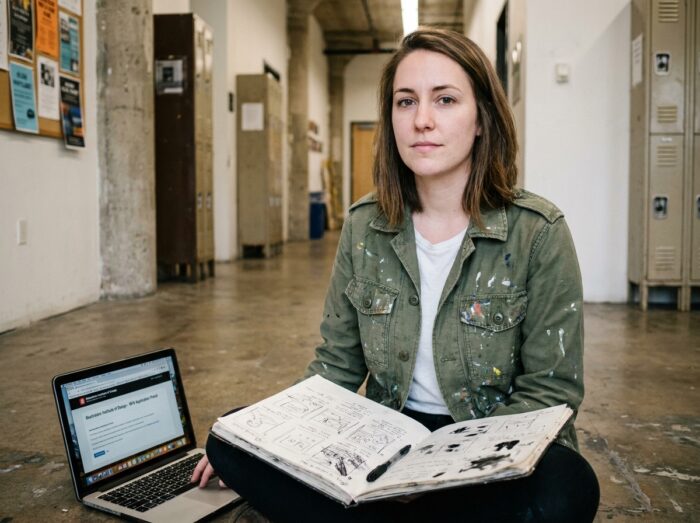
Preparatory year in applied arts: who it really serves
The preparatory class (art prep, MANAA, or leveling depending on the terminology) represents a bridge between self-taught practice and the pace of a degree program. Its usefulness depends on the profile.
A candidate who has been drawing regularly for several years, who already has a solid visual culture, and who has started exploring digital tools can attempt direct admission to the first year of the illustration program. The prep would make them lose a year on already consolidated skills.
On the other hand, for someone whose practice is limited to a personal sketchbook and who has never worked with color, volume, or typography, the preparatory year structures the learning that free drawing does not cover. It also imposes an intense production rhythm, with weekly submissions, that prepares for the pace of graphic arts training.
The decision criterion boils down to one question: can the candidate produce a coherent portfolio without external support? If the answer is no, the prep fulfills exactly this function.
The trajectory between the sketchbook and the school is not linear. It involves visual culture, partial learning of digital tools, methodical construction of a portfolio, and, depending on the profile, a transitional year. Each step can be prepared in a few months of targeted work, not in years of doubt.