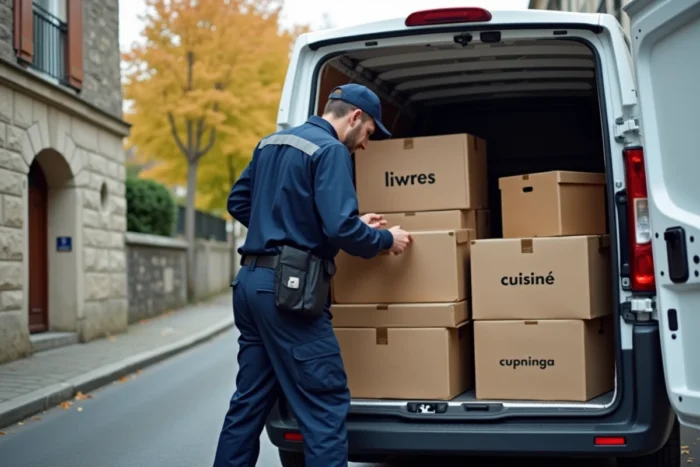
We’re moving a studio, clearing a basement, transporting debris after a construction site: each time, the question of usable volume arises. The 4 m³ is the format commonly found among most utility vehicle rentals and in small self-storage boxes. However, the gap between what the volume theoretically allows and what the payload limits in practice often surprises at the time of loading.
Payload vs. volume: the real limiting factor of a 4 m³
When we talk about 4 m³, we spontaneously think of the available space. A cube of about 1.80 m long, 1.20 m wide, and 1.30 m high (the dimensions vary depending on the vehicle or the box). The image is simple, the reality is less so.
The volume is almost never the primary issue. In a compact utility vehicle like the Renault Kangoo or Citroën Berlingo, the payload often caps out at a few hundred kilos. We barely fill half the floor with debris or bags of cement, and the vehicle already reaches its weight limit.
To better understand the dimensions and volume of a 4m3, we need to think in two stages: what physically fits, then what is allowed in weight.
With boxes of books or dishes, we saturate the payload long before filling the space. With duvets, clothes, or disassembled furniture made of melamine panels, it’s the opposite: we run out of space while being far from the maximum weight. Always check the payload on the registration document before planning a mixed load.
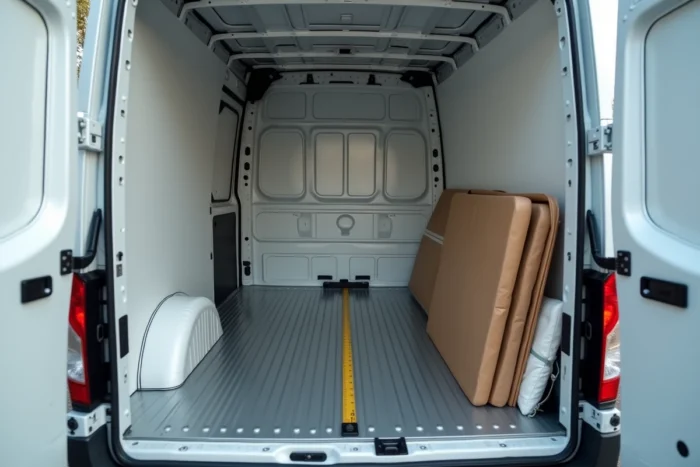
Furniture, boxes, appliances: what really fits in a 4 m³
A 4 m³ does not correspond to an entire apartment. It’s the volume of a very light studio or a well-sorted large room. Here’s what can fit in practice, provided that storage is optimized.
- A disassembled single bed (folded slatted base, rolled mattress or placed vertically), a small dresser, and a folding table, plus a few boxes of clothes.
- A standard washing machine or refrigerator (not an American model), wedged against the wall, with still enough space for about ten medium boxes around.
- Between fifteen and twenty standard boxes (book or moving size) tightly stacked, without bulky furniture, utilizing all the available height.
The classic trap is the sofa. Even a non-convertible two-seater often exceeds 1.40 m in width. In a 4 m³ utility vehicle with a rear opening of about 1.20 m, the sofa simply won’t fit. You end up forcing it, damaging the armrests, or giving up. Checking the dimensions of the opening, not just those of the loading area, avoids this unpleasant surprise.
The case of debris and heavy materials
Transporting debris in a 4 m³ is technically possible, but the payload requires very partial filling. We’re talking about a layer on the floor, nothing more, or risk exceeding the authorized weight and damaging the suspension. Feedback varies on this point depending on the type of vehicle, but the rule remains the same: weigh before loading.
For firewood, the same logic applies. The volume seems sufficient, but the weight saturates quickly. It’s better to plan for two short trips than one overloaded journey.
4 m³ storage box: uses changing with the AGEC law
The 4 m³ is no longer just a moving volume. Since the rise of the AGEC law and the obligation for distributors to take back used furniture, small self-storage boxes are increasingly serving as transition spaces for furniture awaiting collection or resale.
In practice, we store disassembled furniture, pallets, bulky but light items, while coordinating the pickup with a distributor or a second-life channel. This type of filling makes good use of the volume without posing weight issues, unlike “construction” uses.
For long-term storage (furniture storage between two homes, for example), a 4 m³ box is suitable for the contents of a studio or a student room. You can easily stack a disassembled bed, a desk, and a few boxes of books and linens. The self-service access allows you to retrieve an item without emptying everything, provided you have placed the most frequently used items near the opening.
Optimizing the filling of a box or a 4 m³ utility vehicle
The method that works in practice is simple: start with the heaviest and flattest items at the back (bed base, boards from disassembled furniture), then stack the boxes in decreasing order of weight. Duvets, pillows, and bags of clothes fill the gaps last.
- Always disassemble anything that can be taken apart: table legs, shelves, bed frames. An assembled piece of furniture wastes volume due to dead spaces.
- Use straps or blankets to secure fragile items against the walls, especially in a moving utility vehicle.
- Keep an access passage if the box needs to be opened regularly, even if it means losing a bit of total capacity.

4 m³ or 6 m³ utility vehicle: where to draw the line
The 4 m³ is sufficient for a lightly furnished studio, a big clear-out of a basement, or transporting an appliance with a few boxes around. As soon as you exceed the contents of one and a half rooms, or have a sofa and a large piece of furniture like a wardrobe, the 6 m³ becomes the realistic choice.
The advantage of the 4 m³ remains its maneuverability. You can park in the city without difficulty, fit into most underground parking lots, and a standard B license is more than enough. The rental cost difference between a 4 m³ and a 6 m³ is often modest, but the size difference complicates parking in the city center.
The good reflex: list your bulkiest items, measure the widest piece (often the mattress or appliance), and compare with the interior dimensions of the vehicle. If just one item doesn’t fit through the opening, the entire loading plan falls apart.