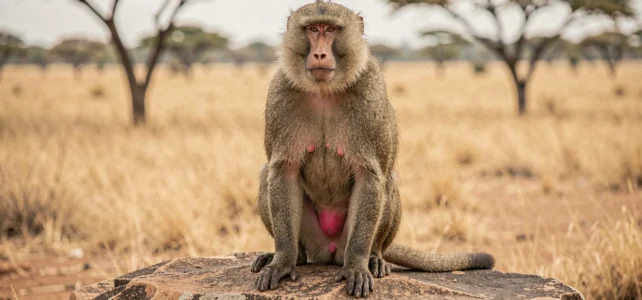
The red coloration of baboon buttocks is not just an aesthetic trait. It results from a precise vascular and hormonal mechanism, the understanding of which has progressed thanks to field studies and endocrine analyses conducted on several species of the genus Papio.
Vascular and Hormonal Mechanism of Baboon Red Buttocks
The perineal skin of baboons is hairless and has an exceptional hair density. This area, called ischial callosity and perineal zone, is supplied by a network of superficial blood vessels whose diameter varies under the direct influence of steroid hormones.
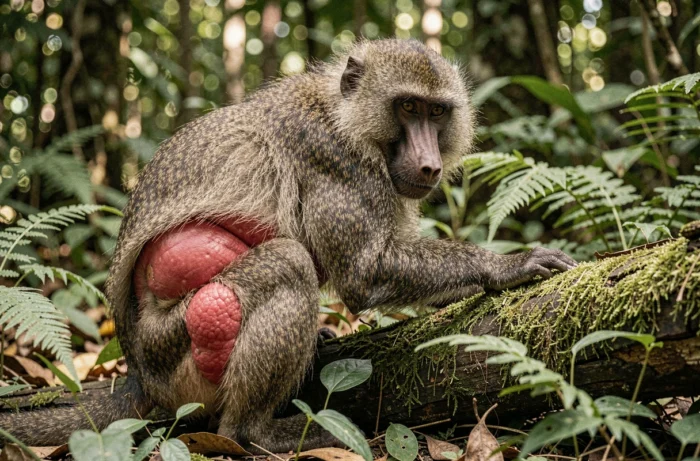
In females, swelling and redness peak during the late follicular phase, when estrogen levels are at their highest. These hormones cause local vasodilation and fluid retention in the connective tissues, generating the characteristic richly vascularized turgor. The red color and volume are therefore not just a simple “color code”: they constitute a highly sensitive hormonal signal, directly correlated to the fertility window.
In males, perineal coloration depends more on androgens and overall physiological status. A male in good body condition, with high testosterone levels, displays a more pronounced coloration. Here we observe functional dimorphism: the same anatomical area encodes different biological information depending on the sex.
To learn everything about the red-bottomed baboon, it must be considered that this coloration constitutes a true physiological dashboard readable by peers.
Environmental Stress and Alteration of Skin Signals in Baboons
Recent work on hamadryas baboons equipped with GPS collars in Saudi Arabia reveals a concerning phenomenon. A notable proportion of their daytime movements now occurs in urban environments: roads, residential areas, tourist sites. This habitat change profoundly alters their diet (access to waste, human food) and their stress levels.
Chronic stress and anthropization disrupt the reproductive cycles of females. Field studies show more irregular cycles and variations in body condition that directly affect the size and duration of the red swellings. From one female to another, the swellings become less predictable and more variable in intensity.
This observation has direct implications for reproductive communication within the group. If the signal loses reliability, males have degraded information to assess the fertility of females. We are potentially witnessing a disruption of sexual selection by an anthropogenic factor, a topic that the literature on urban primates is beginning to document.
Cortisol and Pigmentation: The Endocrine Link
Research on stress hormones in mammals confirms that chronically elevated cortisol interferes with estrogen production. The cascade is logical: less estrogen means reduced vasodilation and diminished swelling. The color loses intensity, and the volume decreases.
This mechanism is not unique to baboons. It fits into an endocrine dynamic documented in many mammals, where skin sexual signals serve as honest indicators of physiological condition, precisely because they are costly to maintain.
Interspecific Variations in Perineal Swelling Among Papio
Not all baboon species exhibit the same degree of perineal coloration. This variation reflects different selection pressures based on social structures.
- The Papio hamadryas (sacred baboon) shows particularly pronounced red swellings in females, linked to a social system where males form harems and competition for access to fertile females is intense.
- In the olive baboon (Papio anubis), swellings are large, and coloration varies from pink to bright red depending on the cycle phase, in a context of multi-male groups where the signal must be readable by several suitors simultaneously.
- The Guinea baboon (Papio papio) presents relatively modest swellings. Recent observations indicate that females of this species do not favor males based on their ability to obtain or share meat, suggesting that other selection criteria may coexist with the perineal visual signal.
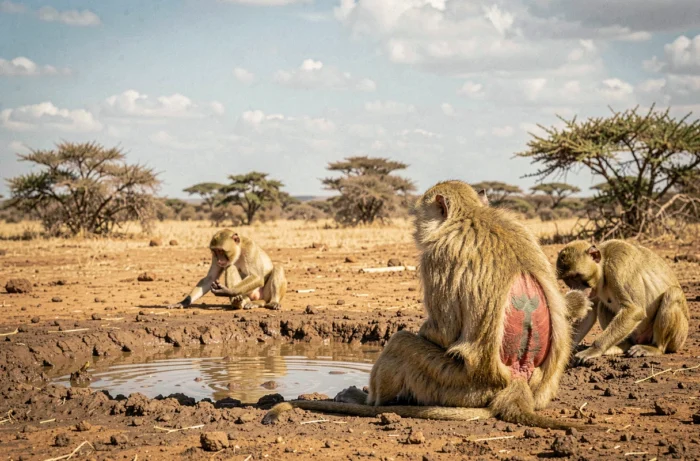
This diversity shows that red swelling is a plastic trait, modulated by the social ecology of each species. It is not a fixed signal but an adaptive response to group structure and the intensity of reproductive competition.
Why Baboon Red Buttocks Remain an Honest Signal
In evolutionary biology, a sexual signal persists in a population only if it is “honest,” meaning difficult to falsify. The perineal swelling of baboons meets this criterion for a simple physiological reason: it directly depends on hormonal state and body condition.
A poorly nourished, parasitized, or chronically stressed female cannot produce as large and colorful a swelling as a healthy female. The metabolic cost of fluid retention and vasodilation makes biological cheating very difficult. Males who base their choice on the intensity of the signal therefore select, on average, partners in better reproductive condition.
Beyond Reproduction: A Marker of Social Status
Perineal coloration also encodes information about social hierarchy. In dominant males, more intense coloration correlates with a high rank and priority access to resources. Agonistic interactions (conflicts, intimidation) can transiently modulate the vascularization of the area, making it a dynamically indicator of hierarchical status.
Females also use this information. In multi-male groups, male perineal coloration contributes to the assessment of potential partners alongside body size or grooming behavior.
The red coloration of baboon buttocks concentrates, in a few square centimeters of skin, a remarkable amount of biological information. Fertility, physical condition, social rank, stress level: all converge towards this anatomical area that primatologists continue to study as a model of honest signaling in natural environments and, increasingly, in anthropized settings.