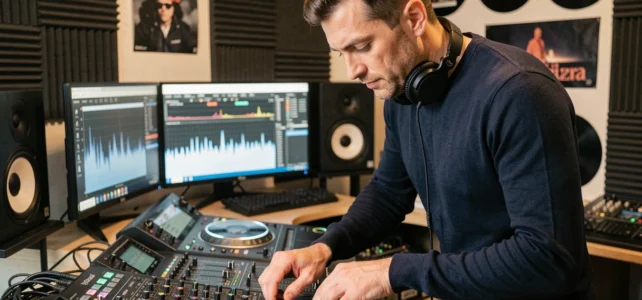
The sound signature of a French DJ is not just about a choice of BPM or a preference for a particular synthesizer. It is a combination of repeated production decisions, embraced material constraints, and a positioning in a market where immediate recognition conditions festival programming. Understanding why the most visible French DJs invest so much in this identity requires examining the technical and economic mechanisms that underpin this approach.
Audio processing chain and routing choices: the technical foundation of a sound style
A signature sound begins in the signal routing. The choice to systematically send kicks into analog saturation, to compress vocals in sidechain on the master bus, or to route pads into a specific convolution reverb creates, piece by piece, a footprint that the listener identifies without naming it.
We observe that enduring French producers adopt a fixed mixing workflow very early on: same buses, same inserts, same compression ratios. This is not laziness; it is coherence. Kavinsky, for example, built his entire aesthetic around vintage synthesizers and deliberately saturated analog processing, to the point that his tracks are recognizable within the first few seconds.
This approach, as detailed by Mon Blog Beauté in a dedicated analysis, relies on the repetition of micro-technical decisions that ultimately constitute a unique sound language. The producer is not searching for a “sound”: they discover it by gradually solidifying their production habits.
Daft Punk took this logic further by building custom instruments and reworking each sample through identifiable analog filters. The entire French touch was defined by a particular treatment of filtered basses and compressed vocals, a technical legacy that has become a cultural marker.
Pressure from festival programmers and fees for French DJs
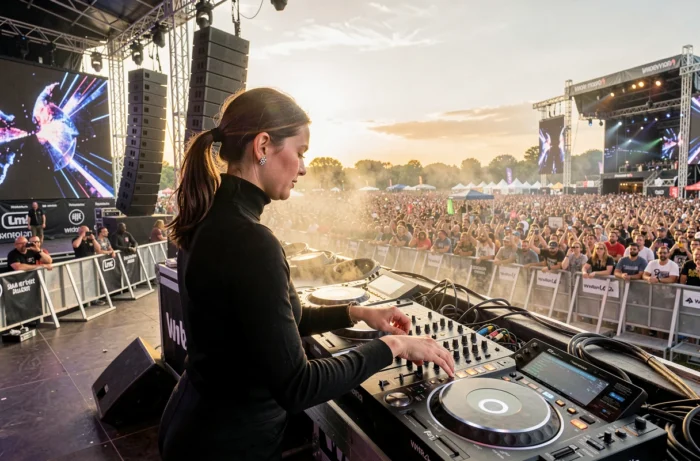
The economic dimension is rarely addressed in articles about artistic identity. A festival programmer who books a DJ for a sunset slot or a closing buys a sound promise. If the artist does not have a clear signature, they become interchangeable with dozens of other names on the shortlist.
An identifiable DJ within a few measures secures their bookings. French and European programmers operate by association: a certain name evokes a specific type of energy, a particular sound treatment. David Guetta understood early on that his ability to impose a recognizable pop-house sound opened doors to stages that pure techno could not reach.
This logic also applies to less media-exposed DJs. On the French techno and house scene, the ability to navigate multiple contexts without diluting oneself, from a Parisian club to an outdoor festival, is described as a central criterion for distinguishing a sustainable artist from a fleeting phenomenon. The DJ who adapts their set to the venue while maintaining their own sonic markers reassures bookers.
Analog sets and hybrid formats against sound standardization
In recent years, a clear trend has emerged on French stages: the proliferation of fully analog sets and hybrid formats combining live music, improvisation, and stage performance. This movement directly addresses a problem of standardization.
When the majority of DJs use the same presets, the same sample packs, and the same DAWs with similar templates, the risk of homogenization is real. The paradox is well-known among labels: they receive demos that all sound like their latest releases because producers mimic what they hear in the existing catalog.
French DJs looking to escape this trap are returning to methods that mechanically impose differentiation:
- 100% analog sets without playback, using vintage machines and real-time improvisation, making each performance unique and non-reproducible
- Hybrid formats merging electronic music with dance, visual arts, or theatrical performance, forcing the artist to rethink the structure of their tracks
- Collaboration with live instrumentalists (strings, brass, untreated vocals) that adds an organic layer impossible to reproduce with a preset
Analog imposes uniqueness through its constraints. An oscillator that drifts slightly, a filter that responds differently depending on the room temperature: these micro-variations create a texture that standardized digital cannot reproduce. It is a costly logistical choice, but it guarantees audible differentiation.
Legacy of the French touch and building a sound identity in Paris
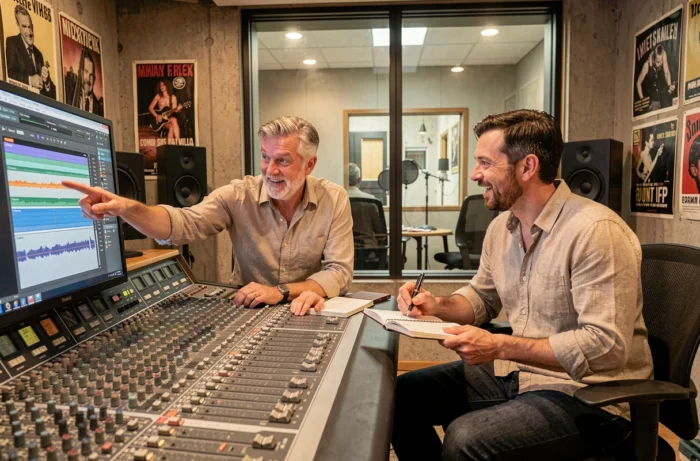
The Parisian scene of the 1990s set a precedent that current French DJs cannot ignore. The French touch was not a genre in the strict sense, but a set of shared production techniques: filtering disco basses, aggressive compression of sampled vocals, massive use of recontextualized funk loops.
What distinguished each artist within this movement was the way they applied these techniques. Daft Punk favored hypnotic repetition and the vocoder. Others explored airier textures or slower tempos. The common framework amplified individual differences rather than erasing them.
This history directly influences the current generation. A French DJ emerging today inherits an expectation: the public and professionals expect them to offer something recognizable. The French market values sound style in a way that other European scenes, more oriented towards interchangeable DJ-tool formats, do not necessarily replicate.
Bob Sinclar built his longevity on this logic, anchoring his identity in a festive and sunny house that allowed him to remain programmed on French radio for decades. The style did not change radically from one album to another, but it evolved enough to avoid monotony while remaining immediately identifiable.
- The consistency of audio treatment over several years forges the public’s auditory recognition
- Positioning within a French musical heritage (disco, funk, house) gives cultural legitimacy that the international market recognizes
- The ability to refuse certain formats or collaborations also defines the signature, by what it excludes as much as by what it includes
The sound signature of French DJs is therefore not a superficial branding exercise. It is an accumulation of technical choices, material constraints, and economic positioning that, repeated over years, ultimately become inseparable from the artist’s name. Producers who neglect this construction find themselves drowned in a catalog of interchangeable sounds, while those who embrace it transform their constraints into a sustainable competitive advantage.