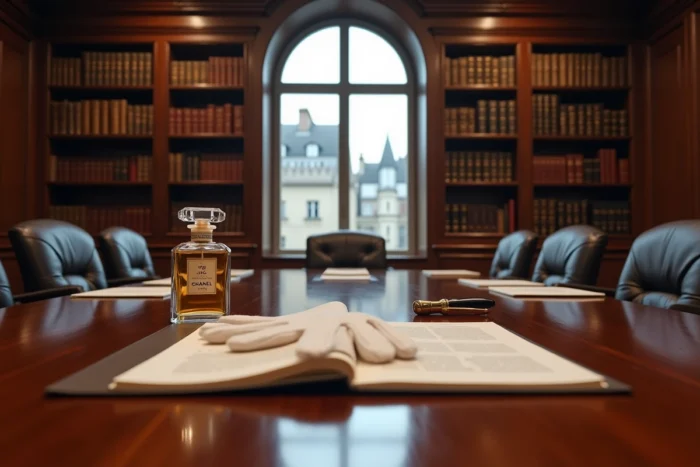
The Chanel house generates revenue that places it among the very top luxury companies in the world. Gabrielle Chanel, who passed away in 1971, had no children. The question of who truly reaps the rewards of this empire merits an examination of the ownership structures, transmission mechanisms, and the players surrounding this extraordinary heritage.
Mousse Partners Family Office and Control of Chanel: Who Owns What
The ownership of Chanel does not go through the stock markets. The company remains privately held by the Wertheimer family, heirs to a partnership established in the 1920s with Coco Chanel herself. Alain and Gérard Wertheimer, grandsons of co-founder Pierre Wertheimer, have led the house for decades.
The management of the family wealth is handled through Mousse Partners, the Wertheimer family office, based between New York, Paris, and London. This structure oversees investments in real estate, banking, and media, far beyond the realm of fashion alone.
A notable recent development involves Arthur Heilbronn, a descendant of the family, a graduate of Harvard Business School, and a former banker at Goldman Sachs. He joined Mousse Partners six years ago and became a director of one of the family office’s main portfolio companies, taking a position that was left vacant after a death within the family. At 38, he embodies the preparation for a generational transition at the top of the empire.
To better understand the fortune and legacy of Coco Chanel, one must look beyond the brand itself and consider the legal architecture surrounding this family wealth.
Wealth Transmission Mechanisms: Holdings, Real Estate Companies, and Disaggregation
The Wertheimer fortune does not rest on a simple bank account passed down from father to son. Families holding wealth of this magnitude resort to specific legal arrangements, common in wealth management in France and Switzerland.
| Legal Tool | Main Function | Advantage for Transmission |
|---|---|---|
| Family Real Estate Company | Ownership of real estate (residences, commercial premises) | Avoids co-ownership, allows for donations of shares with renewable allowances every 15 years |
| Holding Company | Centralizes stakes in operational subsidiaries | Separates decision-making power from capital ownership |
| Disaggregation of Property | Splits usufruct (income) and bare ownership (capital) | The active generation receives income, while the next secures capital with reduced inheritance tax |
| Staggered Donations | Progressive transfer of shares to heirs | Optimizes tax allowances over several decades |
These tools are not unique to Chanel. However, their combination over several generations creates a locking effect that makes the fortune nearly impervious to typical inheritance fluctuations. The structure remains opaque to the public because no publication obligation applies to a non-listed company of this size.
Why Chanel Refuses to Go Public
Chanel has been publishing its financial results for a few years but refuses any public offering. This choice is not trivial. A listing would impose transparency on shareholding, executive compensation, and investment strategy, all elements that the Wertheimer family maintains in absolute discretion.
The refusal to go public protects the family’s strategic freedom. No quarterly pressure from outside shareholders, no activist funds, no race for dividends. The house can invest for the long term in its network of boutiques, production, or acquisitions of subcontractors without having to answer to the market.
Coco Chanel’s Legacy: What the Founder Truly Passed On
Gabrielle Chanel did not pass on ownership of the fashion house at her death. She had already ceded it, for the most part, decades earlier. The partnership with Pierre Wertheimer, signed in 1924 for the production and distribution of Chanel perfumes, gradually gave the Wertheimers control of the entire company.
At her death in 1971, Coco Chanel still owned personal assets, but the house itself already belonged to the Wertheimers. Her will was contested, notably by her former butler, who had become a trusted man, and by distant relatives of her family, who were excluded from the succession.
- Coco Chanel’s biological family received no significant share of the fashion empire, lacking formal legal ties to the company.
- The designated executors included a Zurich lawyer and the Swiss Bankers Association, confirming Switzerland’s central role in structuring the wealth.
- Chanel’s personal estate (jewelry, real estate, cash) followed a distinct circuit from that of the brand, managed by Swiss banking structures.
The brand’s fortune and the founder’s personal fortune have followed two separate trajectories since the 1920s. This point is often misunderstood: the “Chanel” economic legacy benefits the Wertheimers, not the biological descendants of Gabrielle.
Wertheimer Fortune and Overall Wealth Estimation
The total fortune linked to the Chanel ecosystem and the investments managed by Mousse Partners is estimated at around $90 billion. This amount encompasses the value of the fashion house, as well as stakes in prestigious real estate, vineyards, horse breeding, and banking assets.
This estimate places the Wertheimers among the richest families in the world, far ahead of most European luxury dynasties. The uniqueness lies in the concentration: a single family controls the entirety of a group that has never diluted its capital.
An Investment Ecosystem Beyond Luxury
The Mousse Partners family office is not limited to Chanel. The Wertheimers have interests in thoroughbred horse breeding, vineyards, and high-end real estate. Chanel finances a diversified empire of which the fashion brand is only the visible part.
The ongoing generational succession, with Arthur Heilbronn taking on more responsibility, confirms that the family is preparing for the sustainability of this model. The Chanel heritage, built on a century-old commercial agreement, continues to benefit exclusively the Wertheimer circle, in a logic of private transmission that escapes the usual rules of inheritance.