A border massif, a stabilized path, a tree surround to dress: gravel remains the most accessible outdoor covering. The final price depends less on the type of rock than on how you purchase and have it delivered. Understanding these mechanisms allows you to lower the bill without compromising the quality of the result.
Gravel Packaging: The Item That Changes Everything on Price
Have you ever compared the price of a 25 kg bag at a garden center with that of a big bag from a quarry? The difference is often striking. When calculated per kilo, bagged gravel costs several times more than bulk.
Three packaging methods coexist in the market, each catering to a different project volume:
- The 25 or 35 kg bag, sold at DIY superstores, is suitable for a touch-up or a small massif. The price per kilo is the highest here, inflated by packaging and shelf handling.
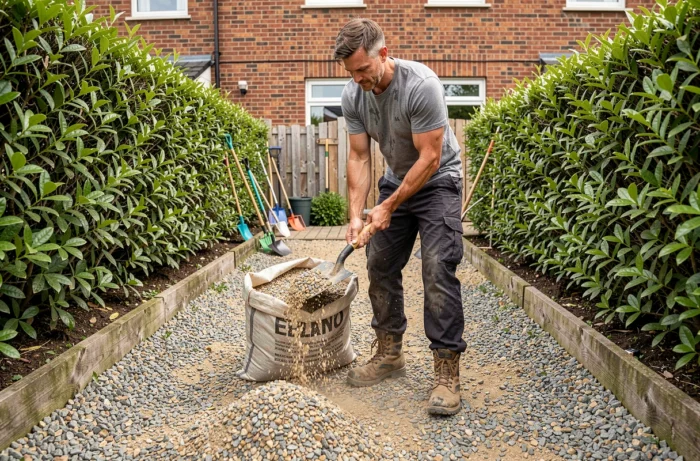
- The big bag (about one ton), ordered from a trading company or directly from a quarry, significantly lowers the unit cost. Delivery by crane truck is added to the quote, but the total remains much lower than the sum of dozens of bags.
- Bulk gravel from the quarry, loaded into a trailer or utility vehicle, represents the floor price. It requires having a suitable vehicle and being able to travel, which is not always possible.
If your project exceeds a few square meters, opt for the big bag or bulk. The savings can amount to hundreds of euros as soon as you need to cover a path or parking area.
By searching for the cheapest gravel purchase, you will find that regional trading companies and local quarries offer prices much lower than national chains, especially for medium to large volumes.
Used Gravel and Construction Surplus: An Underutilized Option
Online guides focus on professional sellers. They overlook a growing practice: recovering gravel from construction sites or individuals.
On classified ad platforms like Leboncoin, offers for crushed or rolled gravel appear regularly. A digger excavating a site, an individual redoing their path: these lots are often sold at very low prices, sometimes for free if removal is quick.
What to Check Before Buying Used Gravel
A good deal requires a minimum of vigilance. The gravel must be free of topsoil, concrete debris, or paint residues. A lot mixed with rubble loses all interest: sorting takes time and the visual result will be poor.
Ask for the grain size and the type of rock. Crushed gravel 6/14 that has been recovered is perfectly usable for a driveable path, provided it hasn’t been mixed with fine sand that would compromise drainage.
Also plan for transportation. A ton of gravel cannot be loaded into a sedan’s trunk. Renting a trailer or having a friend with a utility vehicle help: factor this cost into the calculation to see if the operation remains profitable.
Crushed or Rolled Gravel: Choosing the Right Form Based on Use
The choice between crushed and rolled is not solely aesthetic. It determines the stability, walking comfort, and longevity of your installation.
Crushed gravel interlocks naturally due to its irregular edges. It compacts under weight and withstands vehicle traffic well. For a garage driveway or access path, it is the most technically relevant choice.
Rolled gravel, with its rounded shapes, slips more under feet and wheels. It is better suited for decorative areas: around a massif, at the foot of a fence, in a mineral garden. Its smooth surface makes it more pleasant to walk on barefoot, making it a good candidate around a pool.
Grain Size, A Detail That Changes the Result
Gravel that is too fine migrates with rain. Gravel that is too coarse rolls underfoot and makes walking unstable. For a pedestrian path, a grain size between 6 and 10 mm offers a good compromise. For a vehicle passage, you should move up to 10/14 or 6/14 crushed gravel.
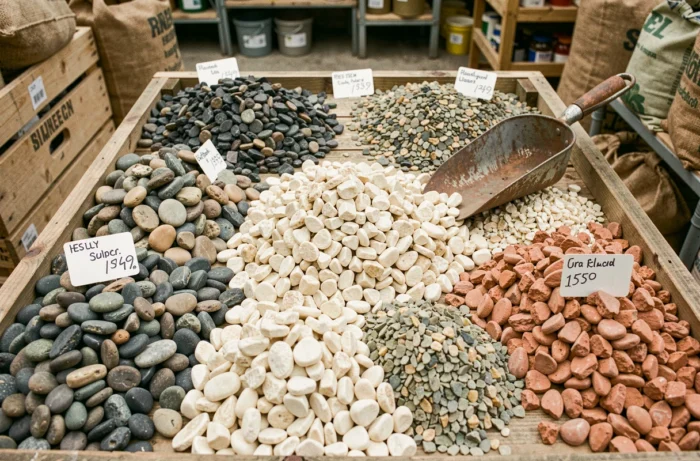
The type of rock also influences the price. Limestone remains the cheapest stone in most French regions, as quarries are numerous. Quartz, marble, or decorative slate cost significantly more, without providing any functional gain on a path.
Reducing the Necessary Volume: The Other Lever for Cheap Gravel
Buying cheaper also means buying less overall. Some design choices can limit the amount of gravel without sacrificing the appearance.
- Installing a geotextile under the gravel prevents mixing with the soil and reduces the required thickness. Without geotextile, you need to compensate by adding several extra centimeters.
- Defining the area with borders (metal, treated wood, recycled plastic) prevents lateral dispersion. Less gravel goes into the lawn, reducing the need to buy more the following year.
- Combining gravel and stepping stones on a pedestrian path decreases the area to cover. The visual effect gains in variety and the budget decreases.
A well-laid geotextile can save one to two centimeters of thickness across the entire surface, which represents a significant volume as soon as the area exceeds a few square meters.
Before placing an order, measure the area in square meters and multiply by the desired thickness. Then request several quotes, at least one from a local trading company and one from a quarry, to compare delivered prices. The delivery item varies greatly from one supplier to another and can alone shift the ranking from cheapest to most expensive.