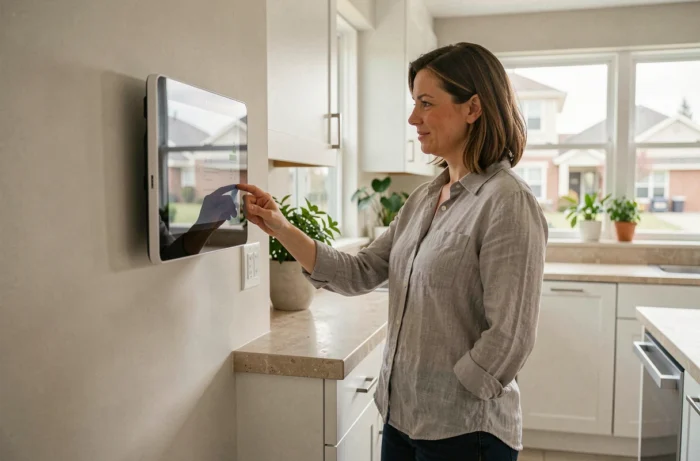
A motion detector that lights up the hallway at night, a thermostat that turns off the heating when you open the window: home automation often starts with a specific domestic annoyance. Transforming your home into a smart one doesn’t require heavy wiring or a huge budget, but a minimum of method to avoid ending up with a pile of connected devices that don’t communicate with each other.
Matter and Thread Protocol: What Compatibility Changes in Practice
You plug in a connected bulb, install the manufacturer’s app, and then start over with a connected socket from another brand. After three different apps, controlling your smart home becomes a puzzle. This is the problem that the Matter protocol is supposed to solve.
Matter provides a common communication layer compatible with Wi-Fi, Ethernet, and Thread. A Matter-certified device can theoretically be controlled from Apple Home, Google Home, Alexa, or Home Assistant thanks to the Multi-Admin feature. In practice, two Matter-certified devices may remain unevenly integrated depending on the platform used. A study published in the European Review of Social Sciences in September 2026 confirms this persistent fragmentation despite the standard.
Thread, on its side, brings a low-power mesh network that allows for local automations without going through the cloud. Here you can find home tips on Eklectik that detail this hands-on approach. Caution: the mention “Matter” on a package does not necessarily mean “Matter over Thread,” as some devices use only Wi-Fi. You need to check for the presence of a Thread border router in your setup to benefit from the mesh network.

Home Automation and Local Operation: Reducing Dependence on the Cloud
When a manufacturer’s server goes down, the connected shutters stop responding. We’ve all read stories of users stuck because a remote service was unavailable. Local operation has become a selection criterion at least as important as compatibility between brands.
With Thread and certain gateways like Home Assistant, automation scenarios run directly on the home network. Cutting off the internet connection does not block the automatic turning off of lights or the regulation of heating. Local operation also protects privacy, as data no longer systematically passes through external servers.
The choice between cloud and local is not always binary. Feedback varies on this point: some devices combine local processing for routine automations and cloud access for remote control from your smartphone. The goal is to keep vital functions (security, heating, lighting) operational even without the internet.
Cybersecurity of Connected Devices: The Cyber Resilience Act Changes the Game
Multiplying connected devices in a home means multiplying entry points for a cyber intrusion. An unsecured surveillance camera, a connected thermostat with a default password that was never changed: vulnerabilities are often trivial.
The European regulation 2024/2847, known as the Cyber Resilience Act, now imposes concrete obligations on manufacturers of connected devices sold in the European Union:
- Mandatory security updates throughout the announced lifespan of the product, and no longer just in the first months after it hits the market.
- The prohibition of identical default passwords across all devices in the same series, forcing a unique configuration upon installation.
- A requirement to report discovered vulnerabilities, with defined deadlines to correct the flaws.
For us, users, this means that a home automation device purchased after the full implementation of the regulation must demonstrate a verifiable minimum level of security. Prioritizing brands already committed to this compliance allows for anticipating regulatory deadlines without waiting.

Simple Steps to Secure Your Home Automation Setup
You don’t need to be a network specialist to reduce risks. Segmenting your Wi-Fi by creating a dedicated network for connected devices (most recent routers allow this) limits the spread of a potential compromise. Updating the firmware of each device as soon as a notification appears remains the most effective reflex.
Connected Heating and Energy Savings: Managing Your Consumption Daily
The connected thermostat is often the first home automation purchase, and for good reason: it’s the one whose return on investment is measured the quickest. Programming time slots and turning off the heating when absent is enough to significantly reduce the energy bill without any loss of comfort.
Recent thermostats go further than simple programming. Coupled with window opening sensors, they automatically turn off the radiator in the affected room. Associated with an outdoor temperature probe, they anticipate heating needs based on the weather. You can now also control certain heat pumps remotely via dedicated apps, with real-time consumption tracking.
Lighting automation complements this logic. Presence detectors in passage rooms (hallway, garage, entrance) eliminate forgetfulness. Connected sockets allow for cutting off standby power to energy-hungry devices according to a defined schedule.
Where to Start Practically
Instead of equipping the entire house at once, start with the room that poses the most problems: the overheated living room, the poorly ventilated bedroom, the entrance that’s always dark. A connected thermostat, one or two sensors, and a single app already cover most needs. You can then add piece by piece, checking the Matter or Thread compatibility of each new device before purchase.
- Check that your internet box supports creating a separate Wi-Fi network for connected devices.
- Choose a first Matter-certified device to lay the foundation for an open ecosystem.
- Install a connected thermostat in the room where you spend the most time, then measure the effect on consumption after a month.
- Consult the compliance mentions of the Cyber Resilience Act before any purchase of a camera or connected lock.
The most useful home automation is the one you forget after setting it up. If a scenario requires daily manual intervention, it is poorly designed. A good home automation system works without you having to think about it, and that is precisely what makes it easy to live with.