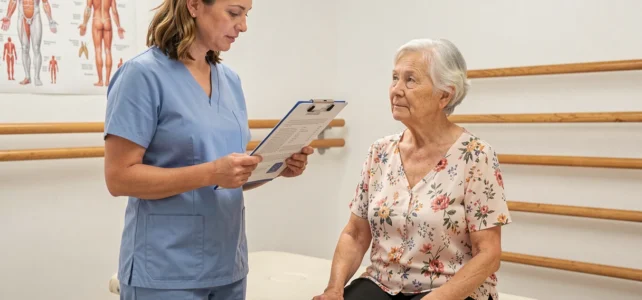
In geriatric consultation or home visits, there is often a need for a reliable paper support to assess the balance of an elderly patient. The Tinetti test is one of those tools that is often sought at the last minute, between two appointments, without always finding a complete and legible version. Having a ready-to-print PDF with the 16 standardized items avoids approximations and allows for comparison of scores from one evaluation to another.
Scoring the Tinetti test: what the score out of 28 points really indicates about fall risk
The Tinetti test, designed by Mary Tinetti in 1986, evaluates mobility through two complementary components. The static balance section includes 9 items scored out of 16 points. The walking section has 7 items, scored out of 12 points. The total thus reaches a maximum score of 28 points.
The scoring logic is the opposite of that of many geriatric scales: the higher the score, the better the mobility. A result above 24 points indicates a low risk of falling. Between 19 and 24, the risk becomes moderate. Below 19, the risk is considered high.
You can easily obtain the Tinetti test to print in PDF format to have a complete grid with all the items and interpretation thresholds directly on the document.
The necessary equipment remains minimal: a chair with a rigid back, the patient’s usual mobility aid (cane, walker), and about five minutes. It is this simplicity that makes it such a widely used tool in offices, nursing homes, or during home assessments.
Limitations of the Tinetti test used alone to assess balance
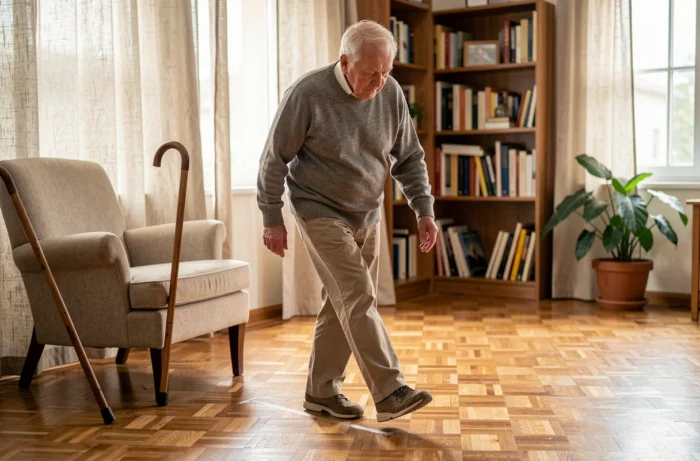
An isolated score is not sufficient to predict a fall. Recommendations from the World Falls Guidelines of 2022 emphasize a multifactorial assessment of fall risk, which incorporates the home environment, medication treatments, vision, and cognitive disorders.
The Tinetti test also has limitations in sensitivity to change. For certain profiles of highly deconditioned patients, the difference between two assessments can be difficult to interpret. Feedback on this point varies among teams and usage contexts.
Combining the Tinetti with other mobility tests
In clinical practice, the Tinetti is often combined with the Timed Up and Go test. This second timed test (getting up from a chair, walking three meters, turning around, returning, and sitting down) adds a temporal dimension that the Tinetti does not capture.
- The Tinetti details the quality of movement item by item, which directs rehabilitation towards specific deficits (step length, symmetry, pivoting).
- The Timed Up and Go measures the overall execution speed, useful for tracking functional progress over the weeks.
- Single-leg support and the sternum push test complete the picture when a vestibular or proprioceptive disorder is suspected.
Crossing two or three tests provides a more reliable clinical picture than a single score. The Tinetti remains the foundation, but it benefits from being interpreted as part of a whole.
Printing and filling out the Tinetti test: practical constraints to anticipate
Not all PDF versions circulating online are equal. Some use a scoring system out of 35 points with 22 items, derived from a modified version sometimes used in nursing homes, where the balance section is scored out of 26 and walking out of 9. Others adhere to the original version with 28 points and 16 items.
Before printing, check three things:
- The number of items corresponds to the version typically used in your service or office, to ensure comparability between successive evaluations.
- The item titles are detailed enough for another professional to review and interpret the grid without ambiguity.
- The interpretation thresholds (low, moderate, high risk) are included on the document, which avoids having to look for information elsewhere at the time of feedback to the patient or family.
Paper version or integrated digital form in the patient file
Patient record software in geriatrics increasingly incorporates scoring forms directly into the care pathway. The total score calculation is done automatically, and the history of assessments becomes accessible with one click.
However, the paper version remains useful in the field. During home visits, access to the software is not always available. In nursing homes, some caregivers prefer to score on paper during observation and then transfer it to the file. The printed PDF remains a daily working tool, not an obsolete tool.
Adapting the administration of the Tinetti test to the patient’s profile
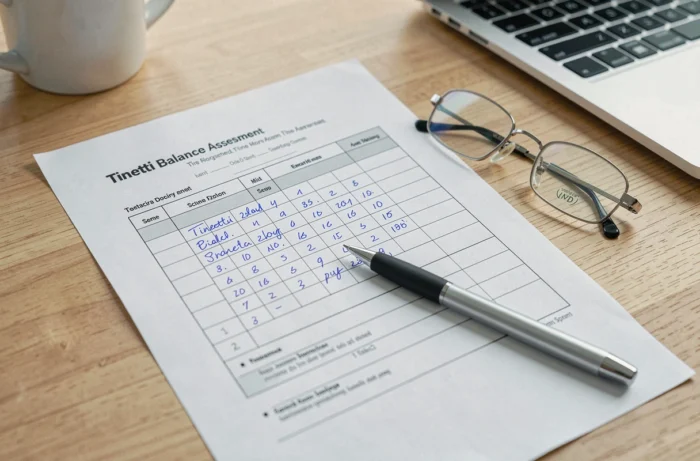
The framework of the test requires that the patient wears their usual shoes and uses their regular mobility aid. Changing these conditions (barefoot, without a cane) skews the comparison from one session to another.
For a patient with moderate cognitive impairments, understanding the instructions may slow down the administration. We rephrase, demonstrate the action, but do not physically guide. The goal is to observe spontaneous ability, not assisted performance.
For very fragile patients, unable to stand without human assistance, the floor score quickly reaches its limits. The Tinetti was not designed to differentiate levels of severe dependence. In these situations, other scales (such as the Berg scale) offer finer granularity on seated balance.
The Tinetti test remains a solid first-line tool for identifying fall risk before it materializes. Its strength lies in its speed and reproducibility. Its limitation is that it does not replace a complete clinical examination or the reasoning of the professional administering it.